
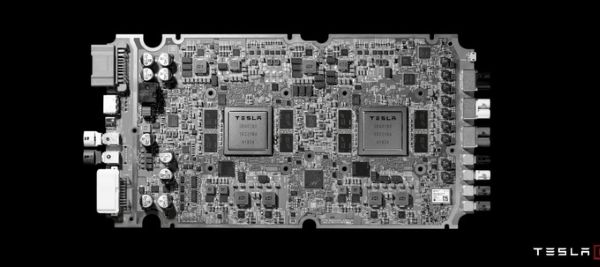
Tesla has reignited controversy after it did not answer a key question from owners of vehicles equipped with its older self-driving hardware, HW3, during its 2026 third-quarter earnings conference call. It presented a timeline for introducing unsupervised Full Self-Driving (FSD) to customer vehicles, but gave no clear explanation on computer upgrades and compensation measures for existing HW3 cars.
On Oct. 22 local time, electric-vehicle outlet Electrek reported that the issue is whether owners of HW3 vehicles who bought unsupervised FSD can receive free hardware upgrades, and when related plans will be disclosed.
The question ranked fifth by share count on retail shareholder Q&A platform Say. A total of 557 votes and 652,900 shares were allocated to the question. Tesla answered lower-ranked questions, but did not address the HW3 question.
Travis Axelrod, Tesla's head of investor relations, ended the Q&A after reading nine questions from Say. There was no further explanation related to HW3, AI3 or hardware retrofits.
The silence drew attention because Tesla presented a specific schedule for the rollout of unsupervised FSD in customer vehicles on the same conference call. Ashok Elluswamy, Tesla's head of AI, said the same software used for the Model Y robotaxi and Cybercab would also be provided to customer cars with FSD v15.
He pointed to the second quarter of 2027 as the time when the first customer vehicles would join the robotaxi fleet. The schedule, however, is focused on HW4-based vehicles, and does not mean unsupervised FSD will be provided to older HW3 cars at the same time.
The concern among HW3 owners stems from previous remarks by Tesla executives. Elon Musk, Tesla's chief executive officer, acknowledged in the first-quarter 2026 earnings release that HW3 does not have the capability to implement unsupervised FSD. He cited as a limitation that its memory bandwidth is one-eighth of HW4's.
That has fueled controversy as Tesla previously sold cars while promoting them as having the hardware needed for FSD. HW3 owners bought FSD for a fee, but they may effectively be excluded from Tesla's current plans for unsupervised FSD.
Musk did not completely rule out the possibility of upgrading HW3 vehicles. In April, he mentioned replacing vehicle computers and cameras at microfactories, small-scale production facilities in major cities. He also raised the possibility of trade-in discounts to reduce the burden of upgrade costs.
In July, he said there would be a point when an upgrade becomes an economically reasonable choice. He also mentioned a plan to skip HW4 and switch directly to AI5, a next-generation board. But detailed costs and timelines, eligible vehicles and replacement procedures were not disclosed. The third-quarter earnings release also did not mention related plans.
The controversy over HW3 has also led to legal disputes. Tesla has sold FSD for as much as $15,000 and is facing related class-action lawsuits in the United States, China and Australia. A collective claim involving about 7,000 HW3 vehicle owners is also under way in the Netherlands.
Documents related to the Netherlands' vehicle certification and oversight agency RDW were reported to include details that Tesla submitted only HW4 vehicles for FSD approval in Europe. That shows that questions over the feasibility of HW3 functionality and regulatory approval remain separate issues.
Tesla provided a light version of FSD v14 with reduced functions to HW3 vehicles this year. But the version is a driver-assistance function that requires continuous driver supervision, and differs from unsupervised FSD that drives without driver intervention.
In the end, the core of the HW3 controversy is not only the pace of autonomous-driving technology development. The key is how Tesla will provide functions that paying customers expected at the time of sale, and whether it will 마련 alternatives such as upgrades or compensation if hardware limits make implementation difficult.
Tesla presented plans for future businesses such as robotaxis, Optimus, FSD development and expanded factory production, but did not offer specific measures for existing HW3 customers. With a timeline presented for rolling out unsupervised FSD in customer vehicles, attention is focused on when Tesla will disclose upgrade and compensation plans for HW3 owners.
 Jinju Hong
hongjj@d-today.co.kr