
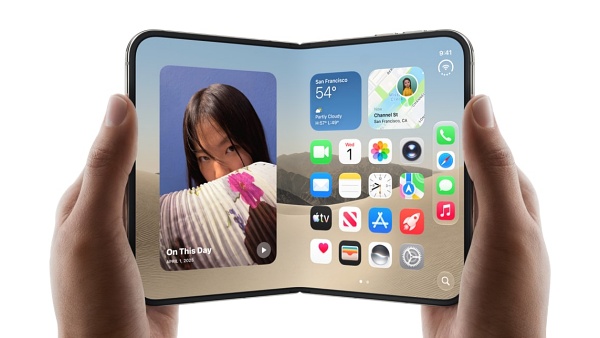
Apple is reportedly testing Face ID on prototypes of its next foldable phone, the iPhone Duo2.
The tech outlet 9to5Mac reported on Oct. 22 that Bloomberg's Mark Gurman said Apple is testing prototypes that place Face ID sensors under the external display.
In the first-generation iPhone Duo, Touch ID on the power button was used instead of Face ID, which some users cited as a disappointment. Some also pointed to Touch ID as the hardest part to get used to on Apple's foldable device.
An ultra-thin design was cited as a reason Apple could not include Face ID in the first-generation model. The report said it was difficult to fit Face ID into a thin body. Apple has recently been reducing the size of Face ID components and refining the design to make them less conspicuous, like the infrared (IR) camera on the iPhone 18 Pro.
There has also been speculation that more advanced features could be used in the iPhone Duo2 and a 20th anniversary iPhone Pro model. That could include hiding not only the IR camera but also the flood illuminator behind the screen, further reducing the bezel or the cutout for the Dynamic Island.
Still, a prototype does not necessarily lead directly to a product launch. Even if Apple is testing the technology, it cannot be certain it will be included immediately in a 2027 follow-up model. If development is delayed, the rollout could be pushed back to the next generation, the iPhone Duo3.
Apple is also considering adding an Action button to the next iPhone Duo, but that too remains uncertain. Even if Face ID is added, it has not been decided whether Touch ID on the power button will be removed or whether both biometric authentication methods will be kept. Ultimately, the key points to watch for the next iPhone Duo are how thinly and naturally Apple can implement Face ID within a foldable design, and how it handles using Touch ID alongside it.
 Yoonseo Lee
yslee@d-today.co.kr