
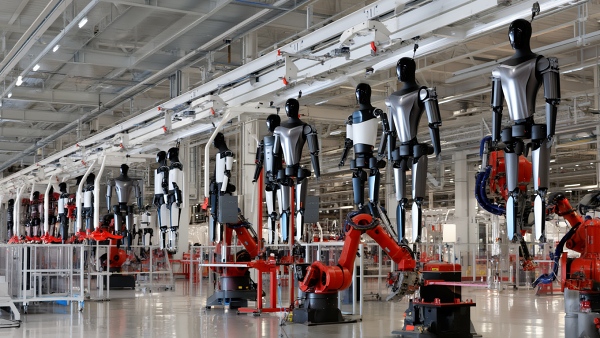
Tesla has started producing its humanoid robot Optimus and plans to begin customer deliveries by the end of next year, it said.
Business Insider reported on Oct. 22 that Tesla CEO Elon Musk (일론 머스크) said on an earnings conference call that the way Optimus learns is similar to an infant’s development process.
The key is securing data. Tesla’s self-driving model can learn from large-scale vehicle driving data, but Optimus must learn by watching people work and repeatedly performing tasks itself. Musk said this difference “resembles the process in which an infant first stumbles and cannot do anything well, then gradually learns many things.”
Musk stressed that Optimus needs to “play” at scale to perform real-world tasks well. He said Tesla is building an “Optimus Academy” where it practices various tasks and creates training data, and that prototypes will repeatedly carry out a wide range of assignments to generate the data needed to train the next model.
He also outlined a plan to scale up production. Musk said Tesla needs to build many robots to secure the training data required for Optimus, and that 10,000 to 20,000 robots must conduct repeated learning through an autonomous sparring-style method. He said increasing robot numbers first would also allow the company to accumulate data needed to improve performance.
Musk acknowledged the possibility of setbacks early in mass production. “Production will be somewhat bumpy,” he said, adding that humanoid robot development still has a long way to go. He cited designing robot hands that are durable yet move sensitively, and developing artificial intelligence (AI) that can handle unspecified, open-ended tasks, as key challenges.
The approach also aligns with a broader challenge across the robotics industry. Unlike large language models (LLMs), which are trained on vast amounts of online text, robots lack real task data needed to deal with the physical world. That is also why Tesla is seeking to create data itself by using a dedicated training space and large numbers of robots.
Tesla also said it began producing Optimus at its Fremont factory that day. As a result, the Optimus business is moving beyond the proof-of-concept stage into a phase of expanding manufacturing and learning infrastructure together. Key points to watch will be whether mass production proceeds as planned and how quickly the “Optimus Academy” can improve real-world task performance.
 Jinju Hong
hongjj@d-today.co.kr