
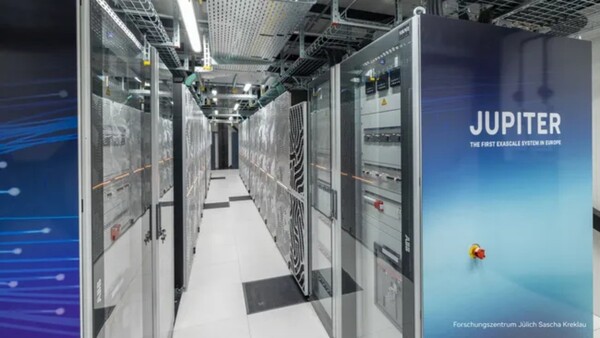
Nvidia conducted a 104-qubit quantum computing simulation on Germany’s Jupiter (JUPITER), Europe’s first exascale supercomputer, and tested a technique that can cut by 90 percent the physical-qubit resources needed for error correction. Using a high-performance GPU supercomputer, it analysed error characteristics in large-scale quantum systems and confirmed the potential to reduce resources needed to build practical fault-tolerant quantum computing.
Tech outlet TechRadar reported on Oct. 22 local time that Nvidia researchers ran the simulation at the Juelich Supercomputing Centre in Germany. The research focused on technology to efficiently prepare magic states, special quantum resources needed to correct errors that occur in quantum processors.
The key is Magic State Cultivation. For a quantum computer to perform complex operations accurately, it must suppress errors caused by interference from the external environment. As the scale of a quantum system grows, managing errors becomes harder, making it important to reduce the number of physical qubits needed while maintaining computational accuracy.
A distinguishing feature of the study was that it incorporated noise conditions close to real quantum hardware in the simulation. It was designed to analyse realistic error patterns rather than simulations that assume ideal environments.
Earlier, Juelich ran a 50-qubit simulation under ideal conditions. This time, it expanded the scale to 104 qubits and tested the performance of the error-correction technique while also considering realistic noise.
Nvidia researchers confirmed in the process that Magic State Cultivation could cut by 90 percent the physical-qubit resources required for error correction compared with existing methods. The results came from a simulation, and further verification is needed on whether the same level of resource savings appears in actual quantum processors.
Nvidia Chief Executive Jensen Huang (젠슨 황) stressed that complex fault-tolerant systems are needed to deliver useful quantum computing. Understanding how systems operate in large-scale environments is a prerequisite for real-world construction, he said.
Huang said the Juelich research shows that combining quantum processors with GPU-based supercomputers can enable research that had previously been difficult to handle.
Jupiter was used as the computing infrastructure for the study. Researchers ran the simulation based on Nvidia’s GH200 processors and scaled computing tasks to as many as 8,192 GPUs.
Before running full-scale simulations on a large system, Nvidia first tested the method on the GB200 NVL72 system at its Nvidia Accelerated Quantum Research Center. It started with 4 GPUs, expanded resources to hundreds to check performance and accuracy, and then scaled the work to Jupiter.
The advance testing also helped cut computing time. Researchers said they reduced simulations that previously took weeks to several days, allowing more efficient use of Jupiter’s computing resources.
On the software side, Nvidia’s cuQuantum and CUDA-Q platforms were used. They were used to implement quantum circuits and Magic State Cultivation operations and to model the behaviour of large-scale quantum systems in a GPU-based classical computing environment.
Large-scale quantum computing simulations can be used to evaluate designs and test error-correction methods before building actual quantum processors. They can also reduce the burden of costly physical experiments in early development and help gauge required hardware scale and resource allocation.
In fields that require complex calculations, such as new drug development and financial modelling, practical quantum computing requires not only scaling computing size but also technology to control errors. If the number of physical qubits needed for error correction can be reduced, it could lower the hardware burden required to build systems.
The achievement, however, is the result of modelling a quantum system on classical computing infrastructure rather than using an actual quantum processor. It remains a task to confirm whether the resource-saving effects seen in the simulation can be reproduced in real quantum hardware.
The industry’s next point to watch is whether Magic State Cultivation can deliver similar efficiency on actual quantum processors. The research is seen not as the completion of practical quantum computing, but as a case showing the role of GPU supercomputers in designing and testing error-correction technology for large-scale quantum systems.
 Jinju Hong
hongjj@d-today.co.kr