
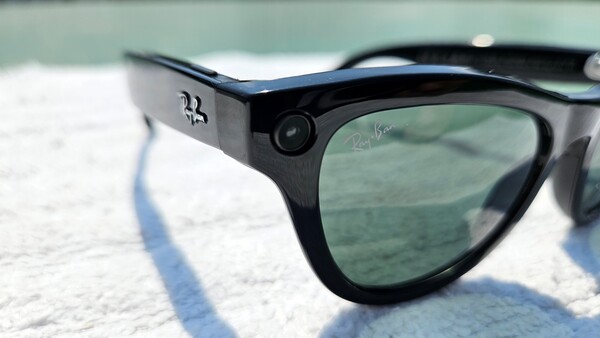
At a parliamentary audit by the National Assembly's Science, ICT, Broadcasting and Communications Committee, AI smart glasses came under scrutiny. With accessories being sold to cover filming indicator lights, there were calls for a government-level response.
Lee Jeong-heon (이정헌), a lawmaker from the Democratic Party, released a video at the committee's audit on Thursday showing real-time footage filmed inside the audit venue using smart glasses. He pointed to the possibility of illegal filming.
Lee showed video of the audit venue on a tablet and said, "This is not recorded footage but video coming in live." He then presented aides wearing regular glasses and smart glasses, saying it was difficult to distinguish whether filming was taking place based on appearance alone.
One representative product, Meta's "Ray-Ban Smart Glasses", has cameras, microphones and speakers built into the frame and provides functions such as taking photos and videos and voice commands. Because it is made in a form similar to regular glasses, there are strong concerns that people nearby will have difficulty noticing whether the wearer is filming.
In particular, the sale of accessories that cover light-emitting diode (LED) indicators that show filming status was cited as a problem. Lee explained that stickers designed to cover filming indicator lights are sold online at about 2,000 won for 40 pieces.
Cases of misuse have already emerged. In a regular TOEIC test in South Korea in May, an attempt at cheating using smart glasses was detected. As concerns have been raised about cheating by photographing test questions or transmitting them outside, the need to strengthen test-site management has grown.
Overseas, moves to regulate smart glasses are continuing. The Australian government is considering banning smart glasses at federal government workplaces, including government buildings, service centres and research institutes. Norway and the Netherlands are also tightening related regulations.
By contrast, there is criticism that South Korea's response to illegal filming and personal information infringement is insufficient. Lee said a related policy study released by the Ministry of Science and ICT will not reach a conclusion until next summer. He argued that measures should be prepared quickly as the spread of smart glasses accelerates.
Vice Prime Minister and Minister of Science and ICT Bae Kyung-hoon (배경훈) said, "We are monitoring market conditions while cooperating with relevant ministries such as the Personal Information Protection Commission and the police." He added, "We will promptly prepare response measures at a government-wide level."
 Lee Jin-ho
jhlee26@d-today.co.kr