
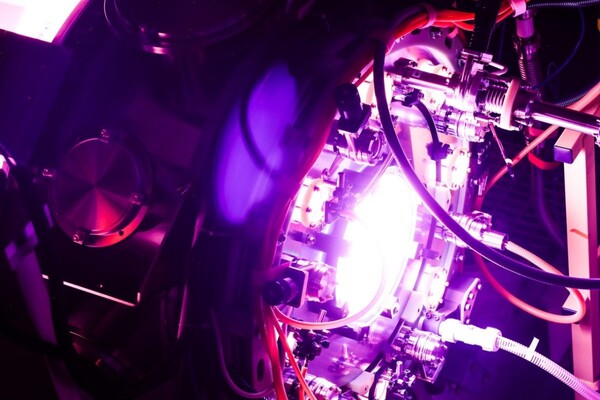
Fusion startup Helion has secured $175 million in funding from the U.S. federal government to develop advanced semiconductors for power plants and strengthen production capability. It plans to reduce losses during power conversion to raise the efficiency of fusion power generation and to build a U.S. supply chain for advanced power semiconductors.
On Oct. 22 local time, tech media outlet TechCrunch reported that Helion will use the funding to bolster R&D and manufacturing capability for high-voltage and pulse semiconductors needed for fusion facilities. The support will be provided over three years under the CHIPS Act, which aims to expand the R&D and production base of the U.S. semiconductor industry.
The key task is to minimise power loss. About 5 to 10 percent of the power flowing through related devices is known to be lost. Helion co-founder and CEO David Kirtley (데이비드 커틀리) said cutting power loss by half could double the output of a fusion system. Individual losses may look small, but their cumulative effect in a complex system is large.
Helion is pursuing a goal of completing its first power plant, Orion, by 2028 and supplying electricity to Microsoft. The grant will be used to build automated production, packaging and testing capabilities for semiconductor modules used in fusion facilities.
Even so, the R&D results are not expected to be reflected immediately in Orion's initial start-up timing. Kirtley said negotiations for federal contracts could take months. The company plans to use the investment to improve the efficiency of future power plants and boost competitiveness in the power market.
The production base will be built in the United States. Helion plans to build a new production line in Washington state. The company said the facility would be the first in the United States to produce a certain class of semiconductors used not only for fusion but also for manufacturing, wastewater treatment, medical and defence industries.
Helion plans to spend more than $100 million in Washington state on semiconductor and advanced packaging R&D. About $80 million will be used, in cooperation with GlobalFoundries, in Vermont for advanced semiconductor equipment and for design and process development.
GlobalFoundries separately received more than $80 million in support from the U.S. federal government to upgrade production of gallium nitride, or GaN, semiconductors widely used in power electronics.
Helion said it also secured a new $50 million in private investment separate from the federal funding. It did not disclose the investors. Including the round, total funding has surpassed $3.2 billion, and the company said it ranks second among fusion startups in funds raised.
Semiconductor efficiency is also closely linked to Helion's fusion power generation method. While conventional generation produces electricity by making steam from heat produced in a fusion reaction and turning a turbine, Helion is developing a method that directly recovers energy generated in the fusion process and converts it into electricity.
The direct energy conversion method pursued by the company uses magnetic fields to accelerate and compress plasma, then converts energy produced by the fusion reaction into electricity through magnets and capacitors. Semiconductor technology that can deliver power quickly and recover it efficiently plays an important role in this process.
Kirtley stressed that modern semiconductors are a core foundation for supplying power to fusion systems and recovering it with high efficiency. Reducing losses in the power conversion process can improve efficiency across the system, he said.
The power semiconductors being developed and produced can be used in various industries beyond fusion. Electric vehicles are currently the main source of demand, and applications are also possible in consumer electronics and the defence sector. Power scale and output requirements differ by field.
Bill Freydenhoffer (빌 프로이엔호퍼), the U.S. Commerce Department's director for semiconductor investment and innovation, said the support will underpin technology that converts and supplies power in key areas including the defence industry, power transmission grids and advanced energy production.
Helion set energy supply in the United States and energy security as priority goals rather than expansion into the defence sector. The investment is seen as a move to pursue commercialisation of fusion power generation while raising the efficiency of generation equipment and securing a U.S. production base for key semiconductors.
 Jinju Hong
hongjj@d-today.co.kr