
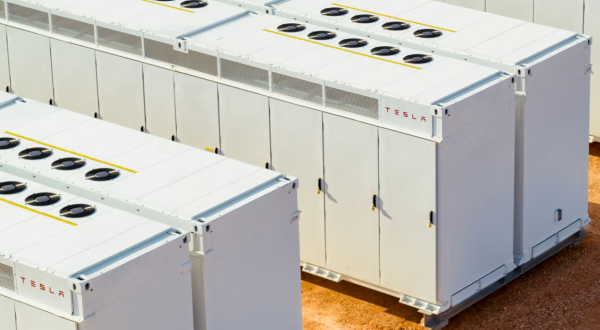
Most of Tesla's 2027 supply of its large energy storage system (ESS) Megapack has been taken up.
Cryptopolitan, a blockchain media outlet, reported on Oct. 22 that Tesla CEO Elon Musk (일론 머스크) said Megapack supply for 2027 was almost sold out and that the company is increasing production as fast as possible to meet demand.
The main driver of demand growth is an increase in artificial intelligence (AI) data centres. The International Energy Agency (IEA) forecast global data centre power consumption would nearly double to 950 terawatt hours (TWh) in 2030 from 485 TWh in 2025.
Expanding renewable energy is also supporting demand for storage. Batteries are needed to offset fluctuations in solar and wind generation. The IEA said new global battery storage installations in 2025 were 108 gigawatts (GW), up 40 percent from a year earlier.
Tesla is also expanding its production base. It began production at its Texas Megapack factory in the third quarter. Based on equipment capacity, annual output capacity is 50 gigawatt hours (GWh) in Texas, 40 GWh in California and 20 GWh in Shanghai. Actual output can vary depending on utilisation rates, parts supply and factory upgrades.
It is also strengthening its battery sourcing base in the United States. Tesla said it shipped its first Megapack made only with lithium iron phosphate (LFP) cells produced in-house at its Nevada factory.
Cost competitiveness for battery storage is also improving. Wood Mackenzie said in a report on Oct. 8 that, in 43 assessed markets, the cost of supplying power from a four-hour-duration battery storage system was lower than from an open-cycle gas turbine. It said gas turbines face rising cost burdens due to supply shortages and fuel price volatility, while batteries are gaining competitiveness as production scales up.
Competition in the market is intense. Chinese companies accounted for 76 percent of the global battery energy storage system (BESS) market in 2025, according to a Wood Mackenzie study released in June. Tesla kept its lead in the North American market, but it also needs to secure price competitiveness while meeting rising demand.
Tesla's overall profitability has deteriorated. Third-quarter revenue was $28.046 billion, similar to the same period a year earlier, but net income under U.S. generally accepted accounting principles (GAAP) fell 43 percent to $787 million. Operating expenses rose 39 percent to $4.776 billion, and operating profit fell 56 percent to $718 million. Higher research and development spending and lower regulatory credit revenue weighed on results.
The key issue going forward is linking the increased Megapack orders to revenue and profit. Attention is on whether it can secure profitability by expanding production and stabilising battery procurement while supplying orders on time.
 Yoonseo Lee
yslee@d-today.co.kr