
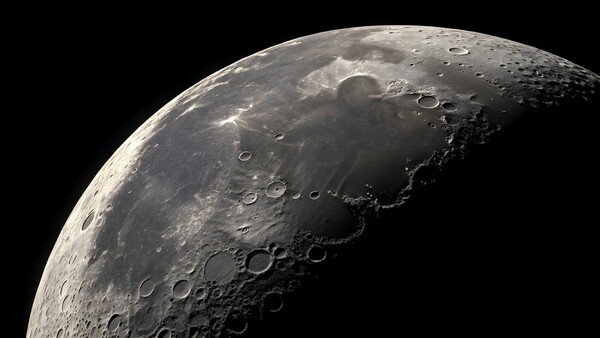
[Digital Today reporter Jinju Hong (홍진주)] Hewlett Packard Enterprise (HPE) is testing high-performance computing (HPC) and artificial intelligence (AI) technology on the moon’s surface. It plans to verify whether it can perform computing and data processing directly on the moon, moving away from the existing approach of sending data to Earth for analysis.
On Oct. 22 local time, online outlet Gigazine reported that HPE plans to demonstrate lunar surface computing technology by putting a small computer called the "HPE Spaceborne Computer-4" on a lunar exploration mission scheduled for launch in the second half of 2026. It will test a range of tasks on the moon, from measuring high-performance computing performance to AI inference, terrain analysis and cybersecurity.
The core of the experiment is to confirm the feasibility of on-site computing that processes data directly in space. Communications between Earth and the moon involve delays and limitations in transmission bandwidth. If data generated on the moon can be analysed on site, it can reduce the communications burden with Earth and improve a rover’s ability to make autonomous decisions and carry out missions.
The Spaceborne Computer-4 used in the experiment is designed with the moon’s extreme environment in mind. It includes a low-power central processing unit (CPU) and graphics processing unit (GPU) and adopts a fanless structure that operates without cooling fans. It is about 25 by 10 cm, similar to a typical graphics card, and uses a 1-terabyte solid-state drive (SSD) for storage. It handles internal heat by transferring it outside through the rover mounting section.
HPE did not disclose detailed specifications such as the specific CPU and GPU models, power consumption or computing performance. The mission is closer to a demonstration project to verify whether a small system can perform various computing tasks rather than a project to install a large supercomputer on the moon.
The computer’s route to landing on the moon has also been detailed. The system is set to launch through the U.S. National Aeronautics and Space Administration (NASA) Commercial Lunar Payload Services (CLPS) programme. It is planned to be carried to near the moon’s south pole via Astrolab’s lunar rover "FLIP", which is loaded onto Voyager Technologies’ lunar lander "Griffin-1".
Two benchmarks to measure high-performance computing performance will be run on the lunar surface. HPL measures computing performance by calculating systems of linear equations, and HPCG evaluates performance related to actual computational work in science and technology. HPE views running these benchmarks on the moon as expected to be a world first.
It will also verify the feasibility of using AI. HPE plans to test retrieval-augmented generation (RAG) using a large language model (LLM) and image recognition inference. LiDAR data processing is also part of the experiment. LiDAR, which uses lasers to measure surrounding terrain, can be used for understanding lunar topography, rover navigation and future lunar surface infrastructure construction.
NASA will also conduct a separate AI experiment called "FLUID". It plans to check the operation of a large language model tuned to search and understand documents inside a spacecraft by linking three AI models trained on Earth, the moon and the International Space Station.
In cybersecurity, Deloitte is participating to test an attack detection system called "Silent Shield". The system aims to analyse and detect signs of cyber attacks and abnormal behaviour in near real time. This means the scope of lunar surface computing use is expanding beyond simple computing performance verification to include security operations.
It will also build infrastructure to support the mission on the ground. HPE will provide "HPE Private Cloud" to Astrolab’s mission control facility in Hawthorne, California. It plans to use "HPE CloudOps Software" to support processing management and automation, and to set up a system to securely transmit analysis results generated on the moon back to Earth.
HPE has experience operating computing systems in the space environment. It sent the first Spaceborne Computer to the International Space Station (ISS) in 2017, and the system recorded performance exceeding 1 teraflops in the HPL and HPCG benchmarks. It has since operated follow-on systems on the International Space Station, and Spaceborne Computer-4 is an attempt to extend related technology to the lunar environment.
The results of this demonstration are expected to serve as an indicator of the direction for computing infrastructure needed for future lunar exploration and construction of a lunar base. If AI inference, terrain analysis and security detection can be performed on site on the moon, it can reduce dependence on communications with Earth and improve the efficiency of exploration missions. It remains a task to be confirmed through the experiment how much computing performance and stability can be secured in the actual lunar environment.
Astrolab will launch its moon rover FLIP to the moon as part of the Griffin Mission 1. On board FLIP will be Hewlett Packard Enterprise's (HPE) Spaceborne Computer-4, an advanced computer module marking the first test of high-performance computing and AI on the moon. #ToTheMoon https://t.co/0MCV5Ode3T
 Jinju Hong
hongjj@d-today.co.kr