
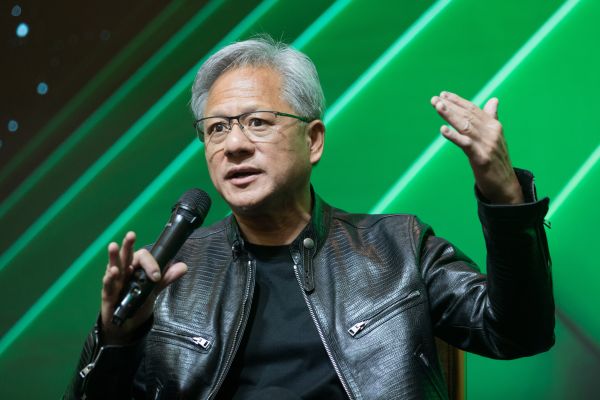
Jensen Huang (젠슨 황), chief executive of Nvidia, forecast that a memory market oversupply in 2029 is unlikely.
On Oct. 22, CNBC reported that Huang said memory stocks had fallen sharply, but demand for memory in artificial intelligence and data centres will keep increasing.
In an interview at Nvidia's GTC Berlin event, Huang said: "One of the greatest things about memory is that you can always use more." He also said high-bandwidth memory will continue to be used in the coming years.
He said Nvidia was the first company to introduce low-power DRAM, or LPDDR, used in mobile phones to data centres, and that it delivered world-leading energy efficiency. He said the energy efficiency is twice that of existing technology. He added that Nvidia will continue to use LPDDR in large volumes.
The recent fall in memory stocks stemmed from oversupply concerns. On Oct. 15, a forecast said the memory market could turn into a "red ocean" in 2029 as the AI boom slows and new supply surges. That fuelled concerns that profitability at major memory makers such as SK Hynix, Samsung Electronics and Micron could worsen.
China's memory maker ChangXin Memory Technologies, or CXMT, has also emerged as a variable. Investor sentiment was affected by concerns that CXMT could eat into the market share of SK Hynix, Samsung Electronics and Micron after it unveiled a new design architecture that could improve efficiency.
Asked about the possibility of cooperation with CXMT, Huang said: "We are open to it." He added: "We are working with Chinese companies, and most of the world is working with Chinese companies in some part of the supply chain." He also praised China's manufacturing capability, saying: "There is no country better than China in manufacturing."
Huang pointed to U.S. export restrictions as a reason behind the faster pace of development in China's semiconductor industry. The United States is restricting exports to China of high-performance semiconductors, including Nvidia's most advanced products. Some Chinese companies are using bypass routes through Southeast Asian data centres to use the computing power of those products, which is assessed to have affected improvements in the performance of Chinese AI models.
Huang said: "All the restrictions definitely accelerated China's development." He said the U.S. curbs instead brought forward localisation of China's semiconductor manufacturing capability and support for related industries.
He stressed that U.S. technology companies remain strong and are ready to respond to competition from anyone. With AI infrastructure expansion, growth in China's semiconductor industry and the possibility of increased new supply overlapping, memory demand is expected to remain a key variable in the market.
 Seung-a Yoo
ysah@d-today.co.kr