
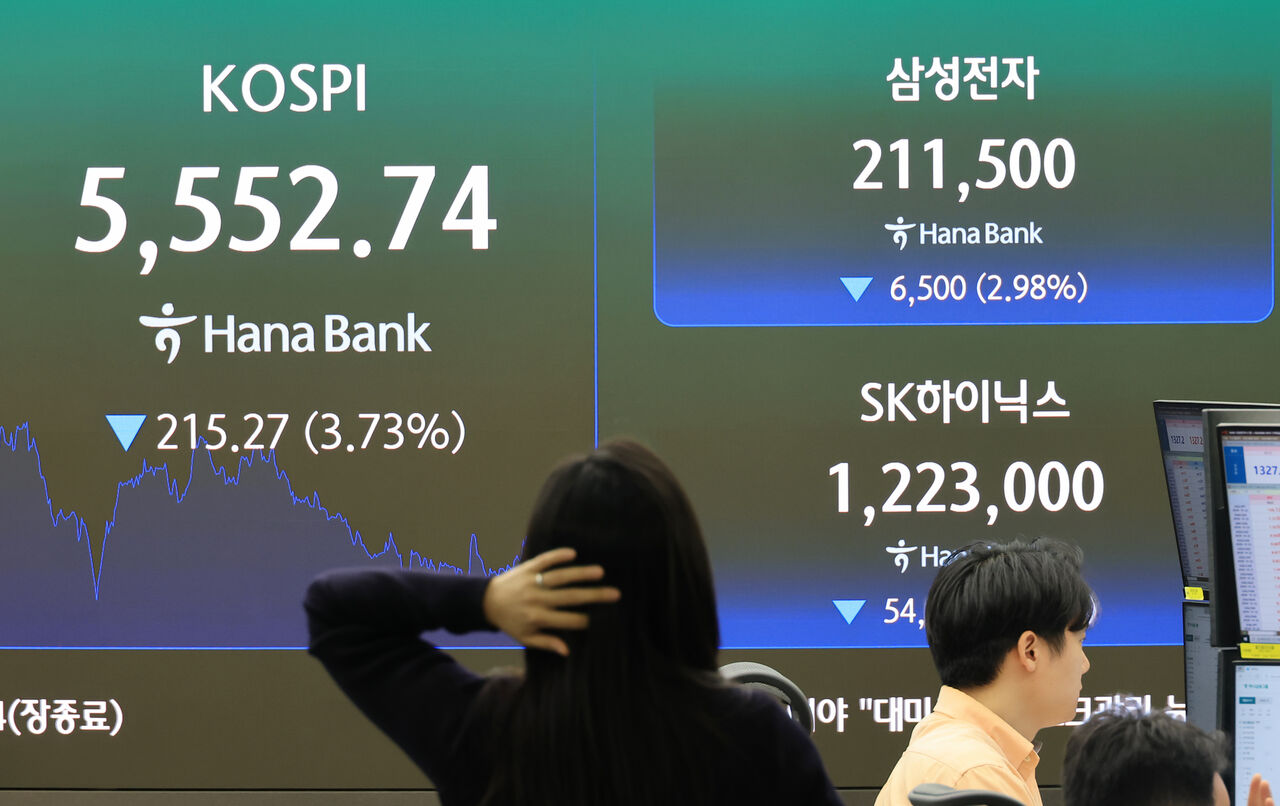
As South Korea's stock market swings sharply, the exchange-traded fund (ETF) market that has rapidly expanded is also stumbling.
According to Korea Securities Depository’s SEIBro (SEIBro) on Oct. 23, total net assets of domestic ETFs stood at 424.737 trillion won as of Oct. 21. That was down 36.374 trillion won from Sept. 22.
Net assets fell as low as 418.981 trillion won on Oct. 20. They recovered by about 5.756 trillion won in a single day on Oct. 21 as the local stock market rebounded. Even so, they were still more than 36 trillion won lower than a month earlier.
That contrasts with the steep growth seen in the ETF market until recently. According to Koscom ETF Check, total net assets of domestic ETFs stood at 457.7 trillion won at the end of September, up 7.6 trillion won from 450.1 trillion won the previous month. The number of listed products also rose by 8 in a month to 1,171.
After that, the local stock market plunged, cutting the valuation of equity ETFs. Funds also flowed out of some themes, quickly dragging down net assets across the market.
By manager, the two leaders, Samsung Asset Management and Mirae Asset Management, posted the biggest declines.
As of Oct. 21, Samsung Asset Management’s ETF net assets stood at 166.99 trillion won, down 12.245 trillion won over the past month. Mirae Asset Management fell by 12.176 trillion won over the same period to 132.328 trillion won.
Combined, the two managers had 299.319 trillion won in net assets, accounting for about 70.5 percent of the entire domestic ETF market. Despite the decline in net assets, there was no major change in the two-leader structure itself.
KB Asset Management was tallied at 32.953 trillion won, down 2.769 trillion won in a month. Shinhan Asset Management fell by 2.151 trillion won to 20.267 trillion won. Korea Investment Management’s net assets were 31.924 trillion won, down 1.639 trillion won.
NH-Amundi Asset Management also fell by 1.484 trillion won to 5.763 trillion won. Hanwha Asset Management dropped by 1.306 trillion won to 10.773 trillion won. Timefolio Asset Management and Kiwoom Asset Management also declined by 1.098 trillion won and 858.1 billion won, respectively.
In the recent downturn, fund outflows were particularly pronounced from ETFs related to semiconductors, artificial intelligence (AI) and leverage.
According to Koscom ETF Check, net outflows totaled 1.6 trillion won from K-semiconductors and 1.2 trillion won from AI. Another 1 trillion won left leverage 2X products, while single-stock leverage and IT saw outflows of 671.5 billion won and 631.1 billion won, respectively.
By contrast, funds flowed into U.S. investments and cash-like products. U.S.-related ETFs drew inflows of 3.2 trillion won in September, while monthly dividend products took in 2.7 trillion won. Money market funds (MMFs) received 1.8 trillion won, and the S&P 500 and Nasdaq 100 themes drew 1.3 trillion won and 1.1 trillion won, respectively.
As volatility rose in the local stock market, funds flowed out of ETFs linked to domestic shares and investment demand was seen as spreading into U.S. indexes and monthly dividend and short-term cash products.
Even so, it is too early to say the long-term growth trend in the ETF market itself has reversed. As of Oct. 21, domestic ETF net assets were up 158.573 trillion won from a year earlier. That is an increase of about 59.6 percent from about 266 trillion won a year ago.
By manager, Samsung Asset Management’s net assets rose by 64.114 trillion won year on year, and Mirae Asset Management’s increased by 46.239 trillion won. KB Asset Management and Korea Investment Management also climbed by 12.785 trillion won and 10.207 trillion won, respectively.
Ultimately, a key variable for competition among managers will be whether the recent decline in ETF net assets remains a temporary drop in valuations tied to a stock market correction, or leads to actual investor fund outflows.
Whether the local stock market rebounds, and whether funds that left equity products such as semiconductors and AI flow back in, is expected to influence the pace of a recovery in ETF net assets.
An official from the financial investment industry said, "As individual investors' exit accelerates following the sharp fall in the local stock market, fund outflows from the ETF market also appear to be increasing steeply." The official added, "Large firms with many products and large net assets are likely to see proportionately larger outflows."
 Sangyeob Oh
yub@d-today.co.kr