
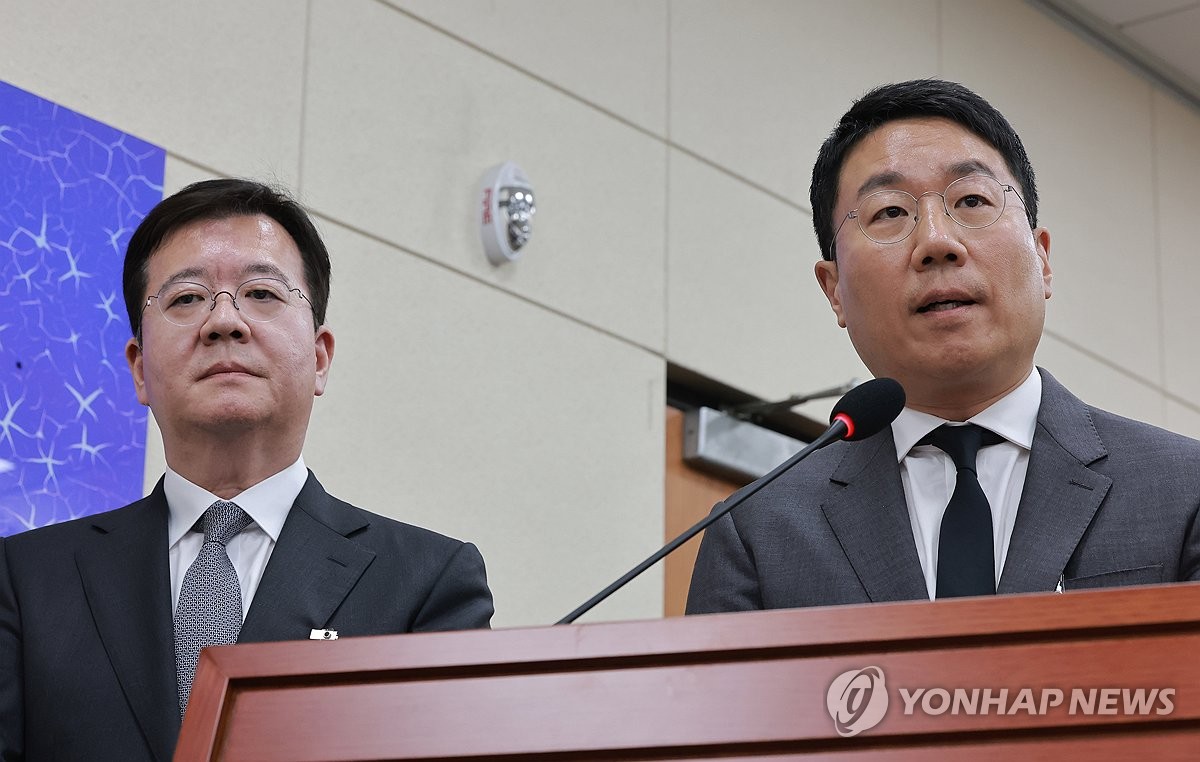
At a parliamentary audit of the Broadcasting Media Communications Committee, lawmakers repeatedly said platforms must strengthen their responsibility to protect users, from domestic platforms such as Coupang and Kakao to global big tech companies such as Google, Apple and X.
At the comprehensive audit of the National Assembly’s Science, ICT, Broadcasting and Communications Committee on Oct. 22, committee chairman Song Ki-heon said questioning continued on issues including protecting teenagers on social media, sanctions over hijacking ads and in-app payments, and blocking illegal information on platforms. He urged each agency to draw up specific improvement measures.
Lawmakers raised a range of issues, including unfair platform practices, responses to illegal and harmful information, and protecting children and teenagers. They also called for swift sanctions for violations of existing laws and institutional improvements to close regulatory blind spots.
Lee Hoon-ki (이훈기), a lawmaker from the Democratic Party, asked Kim Jong-cheol (김종철), head of the committee, about follow-up measures over Coupang’s hijacking ads. Hijacking ads refer to cases where users are forcibly redirected to the Coupang app or related pages even though they did not click the ad.
Kim said the committee had completed a fact-finding investigation into violations under the Telecommunications Business Act and that it was now at the stage of deliberation and a vote within the committee. He said he would report the results soon.
Lawmakers also raised the issue of prior consent for advertising information related to KakaoTalk brand messages. Brand messages are a service that can send advertising messages if users have consented to receive marketing through another route, even if they have not added the company’s KakaoTalk channel as a friend.
Lee said this method could circumvent the principle of prior consent for advertising information. Kim said regulations applied to Kakao and to advertisers are distinguished, and that as far as the committee has determined, Kakao is fulfilling its obligations. He added that the committee would conduct additional reviews and, if needed, supplement laws and systems.
The risks children and teenagers face online and the government’s shortcomings in grasping the situation were also put on the table.
Lee Jeong-heon (이정헌), a Democratic Party lawmaker, said children and teenagers can easily come into contact with strangers on commonly used platforms such as KakaoTalk open chat and Daangn, but protective measures are insufficient.
In a survey conducted by Lee’s office of elementary school students in Gwangjin-gu, Seoul, 31.8 percent of respondents said they had chatted with strangers. Of those, 71.7 percent were found to have experienced risky approaches such as demands for personal information or photos, or proposals to meet.
But the committee was confirmed not to have data on the scale of teenagers’ use of anonymous chat, the status of 피해, and materials from related fact-finding surveys.
Kim acknowledged there appeared to be shortcomings in grasping the status of youth protection in a newly changing environment. He said he intends to strengthen the public responsibility of platform operators and strengthen youth protection through measures including stronger administrative sanctions.
Compensation for damage from telecom company hacking incidents was also mentioned.
Cho Kyung-tae (조경태), a lawmaker from the People Power Party, said the Ministry of Science and ICT and the Personal Information Protection Commission are investigating hacking incidents and pursuing sanctions, but the committee’s role in user protection is relatively insufficient.
Kim said investigations into hacking incidents fall under the Ministry of Science and ICT and personal data leaks are under the Personal Information Protection Commission, but victim relief after incidents is also an area the committee can be involved in.
He said the committee can check whether compensation amounts presented by businesses are sufficient and whether measures under terms and conditions are properly implemented, and can intervene if compensation is inadequate.
The response by global platforms to illegal and harmful information also emerged as an issue. Cho said illegal information such as drug sales and prostitution brokerage is still being distributed on X.
Song also asked Kathleen Lin, head of global public policy and market development for X Asia-Pacific, whether the company could prepare measures by December to limit the spread of illegal posts. Lin said the company would continue response efforts but did not promise a specific deadline for improvements.
Questions also covered delays by Google in deleting illegal information, in-app payment issues, and Meta’s response to harmful information affecting teenagers.
The committee previously said at a parliamentary audit on Oct. 12 that it expected to vote within the month on sanctions related to forcing in-app payments by Google and Apple. With deliberation and a vote on Coupang’s hijacking ads also ahead, follow-up measures against major platforms are drawing attention.
Song said he would reflect the issues raised at the comprehensive audit in future reviews of bills and budget bills.
 Son Seul-gi
sageson@d-today.co.kr