
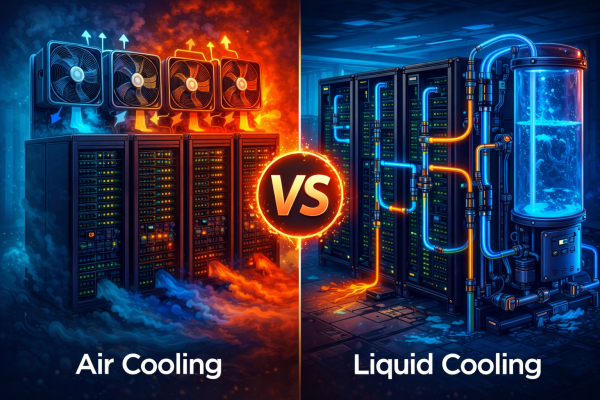
Global data centre power demand is surging as artificial intelligence (AI), high-performance computing (HPC) and cloud services spread, making cooling system efficiency a key infrastructure task. The International Energy Agency (IEA) estimates data centres currently account for about 1.5 percent of global electricity consumption, and expects energy demand to double by 2030 as technologies such as AI expand. With about half of data centre energy use going to cooling, the choice of cooling method is becoming a factor that determines operating costs and sustainability.
Tech outlet TechRadar reported on Jan. 11 that traditional data centres have relied on air cooling using internal fans, but limits are emerging as power density rises sharply with growing AI workloads. As a result, water-based liquid cooling is drawing attention as a high-efficiency alternative. The industry assesses that cooling strategy in AI and HPC environments is emerging as a key variable that will determine data centre competitiveness.
The biggest advantage of liquid cooling (water cooling) is high heat removal efficiency. Water transfers heat more than 3,000 times more efficiently than air, which can significantly reduce the power needed to cool servers. Some technologies that deliver liquid directly to nodes can remove up to 98 percent of the heat generated by servers, and recovered warm water can be reused for building heating or other purposes. Some analyses say this can cut overall power consumption by up to 40 percent.
Liquid cooling technology is also evolving rapidly in terms of sustainability. Existing evaporative cooling methods required water replenishment, but closed-loop liquid-to-air heat exchanger systems have recently spread, minimising water loss. Newer designs that allow higher inlet temperatures are also reducing the energy needed to further cool the water.
Air cooling, by contrast, has major constraints in terms of space and scalability. In general, air-cooling systems can handle power densities only up to about 70 kilowatts, and cannot operate beyond a certain heat capacity. AI GPUs consume up to 10 times more power than conventional CPUs, while designs such as 3D silicon stacking pack more computing resources into the same space. This means air cooling is facing physical limits in high-density AI data centres.
Goldman Sachs projected that data centre power demand could rise by up to 160 percent by 2030 as AI spreads. That means the efficiency of liquid cooling is becoming increasingly important, and improving power usage effectiveness (PUE) is emerging as a key indicator for data centre operations. Some liquid-cooled data centres are already known to have reached PUE below 1.1, and even as low as 1.04.
Differences are also emerging in maintenance and stability. Air cooling uses fans and is vulnerable to dust inflow and temperature fluctuations, while the latest liquid cooling systems have greatly improved safety and serviceability. Hybrid cooling methods that use both air and water are also spreading, lowering barriers to adoption.
Industry officials forecast that, in an AI-centred data centre era, cooling methods are not simply an equipment choice but a long-term infrastructure strategy. They also forecast that, in high-density computing environments, liquid cooling is likely to become not an option but a necessity.
 Jinju Hong
hongjj@d-today.co.kr
Jinju Hong
hongjj@d-today.co.kr