
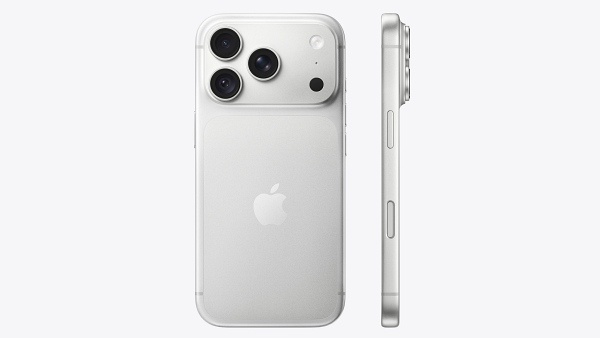
The iPhone 18 Pro leads the iPhone 17 in performance, camera and battery, but it also comes with a bigger price burden.
Tech outlet TechRadar reported on Oct. 10 that Apple is selling the standard iPhone 17 model and the iPhone 18 Pro at the same time. Screen specifications are similar, but there are differences in the camera, processing performance and battery.
The iPhone 18 Pro costs $1,199 for the 256GB model (1.99 million won in South Korea) and $1,399 for the 512GB model (2.29 million won), and it also offers 1TB and 2TB options. The iPhone 17 is $899 for 256GB (1.45 million won) and $1,099 for 512GB (1.75 million won), with no option for higher storage. Based on the same capacity, the gap is $300 in the United States and 540,000 won in South Korea.
The iPhone 17 has also risen in price from its launch. Its 2025 launch price was $799 for 256GB (1.29 million won), but it was increased after the iPhone 18 Pro launch. Apple has previously cited higher memory costs as the reason for raising iPad and MacBook prices.
The most notable hardware difference is the camera. The iPhone 18 Pro has a 48-megapixel wide-angle camera with an aperture that can be adjusted from f/1.48 to f/4.0. It also adds a 48-megapixel ultra-wide camera and a 48-megapixel telephoto camera that supports 4x optical zoom. The iPhone 17, by contrast, has a dual-camera setup of 48-megapixel wide-angle and ultra-wide, and it does not have a dedicated telephoto lens or pro camera controls.
In real-world assessments, the iPhone 18 Pro was rated superior for detail and low-light shooting, and was assessed to deliver strong results at 4x and 8x zoom. The iPhone 17 also has good quality from its two cameras, but there is a gap with the Pro model in flexibility for various shooting situations.
The iPhone 18 Pro also leads on performance. It uses the A20 Pro chip and 12GB of RAM, while the iPhone 17 has the A19 chip and 8GB of RAM. The A20 Pro’s CPU and GPU performance are up to 20 percent and 60 percent faster, respectively, than the A19 Pro used in the iPhone 17 Pro. These figures are not a direct comparison with the iPhone 17 standard model’s A19.
There are also differences in software and artificial intelligence features. Both devices currently run iOS 27, but the iPhone 17 launched with iOS 26, which could lead to differences in future support periods. The iPhone 18 Pro offers some AI features such as richer Siri voice expression, while the iPhone 17 does not support some features due to hardware constraints.
The iPhone 18 Pro has a battery capacity of 4,288 mAh or 4,056 mAh depending on the sales region, while the iPhone 17 has 3,692 mAh. Apple’s stated maximum video playback time is 34 hours and 30 hours, respectively. The time to charge the battery to 50 percent with wired charging is 15 minutes for the iPhone 18 Pro and 20 minutes for the iPhone 17.
Display specifications are largely the same. Both have a 6.3-inch Super Retina XDR OLED display, with a 1 to 120 Hz refresh rate, 1,206 x 2,622 resolution and peak brightness of up to 3,000 nits. The iPhone 18 Pro has a smaller Dynamic Island and can show up to 3 Live Activities at the same time. The iPhone 17 supports up to 2.
The rear layout and weight differ in design. The iPhone 17 uses a glass back and a vertical camera array, while the iPhone 18 Pro adopts a glass panel surrounded by aluminum and a large horizontal camera island. The iPhone 18 Pro weighs 211 grams, 34 grams heavier than the iPhone 17 at 177 grams. Both apply Ceramic Shield 2 on the front and support IP68 water and dust resistance.
The basis for choosing is how useful the added features are. The iPhone 18 Pro is favorable if telephoto shooting, longer battery life, faster charging, high-performance work and some AI features matter. For consumers who value screen quality and everyday use while seeking to cut costs, the iPhone 17 remains a competitive option.
 Yoonseo Lee
yslee@d-today.co.kr
Yoonseo Lee
yslee@d-today.co.kr