
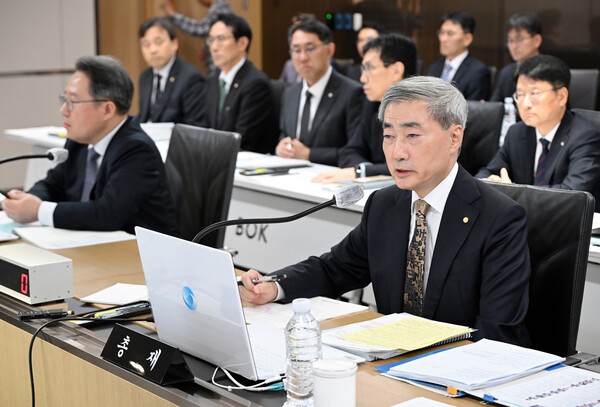
Bank of Korea Governor Shin Hyun-song left open the possibility of additional policy rate hikes at a parliamentary audit, citing inflation pressures and concerns about financial imbalances. He also signalled vigilance over rising home prices in the Seoul metropolitan area and growing household debt. The audit also focused on the Bank of Korea's digital currency pilot, "Project Hangang", and responsibility for responding to single-stock leveraged exchange-traded funds (ETFs).
At a parliamentary audit by the National Assembly's Planning and Finance Committee held at the Bank of Korea in Jung-gu, Seoul, on Oct. 12, Shin said of future monetary policy, "We plan to decide the timing and pace of additional hikes while closely monitoring inflation and economic trends, and financial stability conditions."
The Bank of Korea raised the policy rate by 0.25 percentage points in each of July and August, taking it to 3.00 percent. It says it will decide whether to hike again after considering inflation pressures, the economic recovery and financial market stability.
Possible additional rate hikes... inflation and household debt concerns persist
Shin said the two consecutive policy rate increases were a decision to respond pre-emptively to inflation pressures.
Ahn Do-geol (안도걸), a lawmaker from the Democratic Party, pointed to the burden of rate hikes on domestic demand and on households and companies, and called for an analysis of policy effects and costs.
Shin said that raising rates ahead of the U.S. Federal Reserve (Fed) secured time needed for the market to respond. His point was that a pre-emptive approach could reduce economic costs compared with raising rates while being pressed by market conditions after inflation pressures have intensified.
He also said inflation would likely continue rising for the time being. Shin forecast that inflation would remain above the 2 percent target for a considerable period as accumulated cost pressures feed into prices and demand-side pressures rise amid a consumer recovery.
He stressed that pre-emptively curbing core inflation is important to achieve the inflation target. The Bank of Korea forecasts consumer inflation at 2.7 percent this year and 2.3 percent next year.
A concern was also raised that the government's expansionary fiscal policy could add to inflation pressures and move out of step with the Bank of Korea's tight monetary policy.
Lee Jong-wook (이종욱), a lawmaker from the People Power Party, said large-scale expansionary fiscal policy could, in the short term, burden prices and the money supply, and asked about the possibility of a clash between monetary and fiscal policy.
Shin estimated that the government's budget proposal for next year would lift gross domestic product growth by 0.5 percentage points and inflation by 0.06 percentage points.
He acknowledged that expansionary fiscal policy could increase aggregate demand in the short term and put pressure on prices, but said its additional impact on inflation may not be large. He said the bank is testing with models whether fiscal and monetary policy are actually moving out of step.
The real estate market and the rise in household debt were also cited as key risk factors. Shin said concerns about financial imbalances remain large due to rising home prices in the Seoul metropolitan area and the increase in household debt.
He said rising home prices and expanding household debt could fuel financial market instability, and that the monetary policy decision process should consider not only prices but also financial stability conditions.
Project Hangang personal data controversy... responsibility for responding to leveraged ETFs also raised
The audit also highlighted the nature of the Bank of Korea's digital currency pilot, "Project Hangang", and issues of personal data protection.
Lee Jun-seok (이준석), a lawmaker from the Reform New Party, asked whether Project Hangang is a project to introduce a central bank digital currency (CBDC) and whether personal data could be infringed during the management of transaction information.
Shin said, "Since 2023, the Bank of Korea has not been reviewing a retail CBDC," and added, "Project Hangang, which is being pushed ahead now, is work to tokenise the existing two-tier financial and monetary system as it is, centred on an institutional digital currency."
He said Project Hangang is not a model in which the central bank issues digital currency directly to individuals, but a project that applies the existing monetary system, made up of the central bank and commercial banks, to a digital environment.
On personal data management, he said individual banks manage customer information as in the existing financial system, while the Bank of Korea is responsible for interbank settlements. Citing that structure, Shin stressed there are no concerns about surveillance of personal information through Project Hangang.
On a series of recent hacking incidents in the financial sector, he said multiple safety devices have been built into Project Hangang and that it is a fairly stable system even when considering hacking threats using artificial intelligence (AI).
Another concern raised was that the Bank of Korea's response to single-stock leveraged ETFs was insufficient.
Jung Sung-ho (정성호), a lawmaker from the Democratic Party, said volatility in the stock market increased after the introduction of single-stock leveraged ETFs, but the Bank of Korea did not sufficiently warn of related risks.
In a June financial stability report, the Bank of Korea assessed that the introduction of single-stock leveraged ETFs would help prevent outflows of domestic investment funds overseas and contribute to expanding inflows of overseas funds.
At the audit, Shin said the bank did not sufficiently grasp volatility in the domestic stock market and in memory semiconductor-related shares at the time, and acknowledged that the assessment was not appropriate.
He added, "As the final person responsible for the financial market, I feel sorry for the part where I failed to properly live up to the public's trust."
 Ji-young Lee
ljy@d-today.co.kr
Ji-young Lee
ljy@d-today.co.kr