
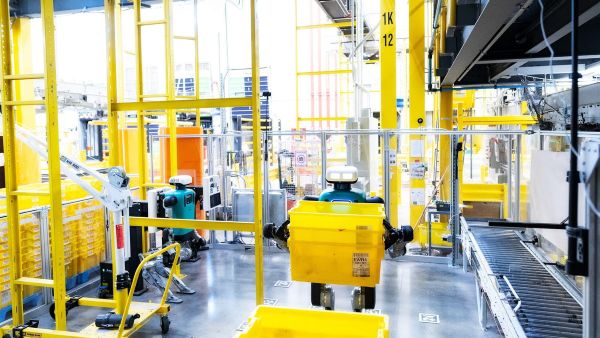
Nvidia is accelerating its push into the physical artificial intelligence market by expanding safety systems used in autonomous vehicles to humanoids and industrial robots. As robots become more advanced, safety has emerged as a key challenge for real-world industrial deployment. Nvidia aims to support robot commercialisation by building an integrated safety framework spanning hardware, software and simulation.
On Oct. 8, local time, IT outlet Ars Technica reported that Nvidia expanded its Halos safety system, introduced for autonomous vehicles in 2025, into NVIDIA Halos for Robotics in June 2026. The scope now includes warehouse autonomous mobile robots, factory humanoid robots and surgical robots.
Nvidia sees safety emerging as the next technical challenge as robots' perception and reasoning capabilities and hardware performance improve rapidly. Amit Goel, Nvidia's head of robotics ecosystem and edge computing, explained that safety is becoming a new bottleneck as robot models and hardware performance increase. He also stressed that in physical AI systems, functional capabilities that perform real work and safety-related functions must operate together on the same silicon.
Halos for Robotics has an integrated structure that combines hardware and software. Nvidia IGX Thor, a computing module for robots and industrial equipment, includes an independent processor dedicated to safety-related tasks. It is designed to separate general robot computation from safety-critical work and reduce the impact of system errors or interference from other tasks on safety functions.
The software continuously checks hardware components and software libraries to detect abnormalities. Nvidia Holoscan Sensor Bridge, which processes sensor input, is also included in the safety framework. It is designed to identify whether sensor data has been corrupted and manage inputs delivered to safety-related computation. The function can also be applied to individual components such as microcontrollers or field-programmable gate arrays.
It also provides simulations to validate robot behaviour in virtual environments and inspection programs to check safety issues during development. This approach supports testing various situations and identifying potential risks before robots are deployed in real workplaces.
Still, it is difficult to apply automotive safety systems to robots as they are. In the automotive industry, standards and verification systems for functional safety are relatively established. Robots, however, have widely varying safety requirements depending on their purpose and operating environment. The same standard is difficult to apply to a robot that cleans indoor floors, an autonomous forklift moving heavy loads in a warehouse, and a humanoid working in the same space as people.
Nvidia has therefore designed the platform so developers can configure safety functions suited to each operating environment. Applying safety standards flexibly while maintaining control and consistency across the overall system is the key challenge.
Goel explained that unpredictable situations can arise in environments such as factories, warehouses and hospitals where structures are not fixed. For example, a robot moving through a corridor may not immediately recognise people or objects approaching from a blind spot or around a corner. If robots are to move autonomously near people, safety mechanisms to handle unforeseen situations are needed alongside sensors and computing systems.
Real-world adoption cases have also emerged. U.S. robotics startup Agility Robotics was introduced as the first company to apply Nvidia Halos to its humanoid robot Digit 5. The robot aims to work around people without relying on separate isolated work areas or physical barriers.
Using Nvidia's safety framework can integrate safety sensors and related hardware inside robots, reducing the burden of having to install separate sensors outside the work area. Goel explained that as safety functions move with the robot, the need to build additional external infrastructure each time it performs new tasks in factories or warehouses could be reduced.
Boston Dynamics also joined as an early partner. The company is pursuing a safety platform that covers the quadruped robot Spot, the logistics robot Stretch and the humanoid Atlas. In Atlas' case, the possibility of deployment at Hyundai Motor factories from 2028 has also been mentioned, raising the prospect that safety verification and real-world application of humanoids will become key tasks in industrial settings.
Germany's KION Group is adopting Halos for autonomous forklifts and autonomous mobile robots. LG was also reported to be pursuing development of its own humanoid using Nvidia's humanoid robot foundation model Isaac GR00T. This reflects a broader trend of safety technology spreading across industry alongside robot hardware and AI models.
Nvidia is fostering physical AI as its next growth area. Chief Executive Jensen Huang (젠슨 황) said on a podcast in March 2026 that the physical AI business is generating about $10 billion in annual revenue. He has previously presented physical AI as one of the company's key growth engines since 2025.
The key question ahead is whether robots can move beyond performing fixed tasks to handling multiple jobs in diverse environments. As their use expands to factories, warehouses and hospitals where people and robots work in the same space, safety could become a necessary condition for robot commercialisation.
That is why Nvidia is expanding safety technology accumulated in autonomous vehicles to a robotics platform. Whether the integrated safety system can be applied to various manufacturers and robots to reduce the risk of accidents and lower deployment costs is cited as a factor that will determine the scalability of the physical AI business.
 Jinju Hong
hongjj@d-today.co.kr
Jinju Hong
hongjj@d-today.co.kr