
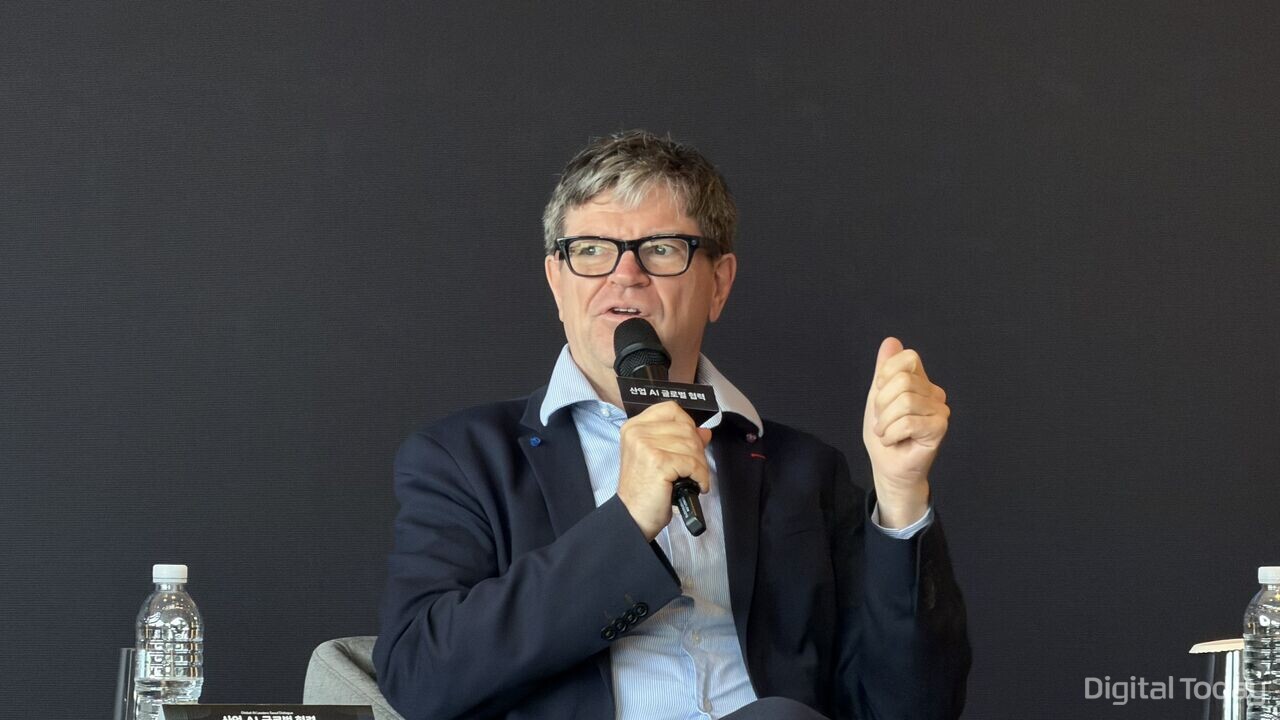
Global AI experts including Yann LeCun (얀 르쿤), chairman of Amylabs, proposed expanding global cooperation, saying South Korea’s development of its own AI models can coexist with international joint development.
LeCun, Christopher Nguyen (크리스토퍼 응우옌), CEO of Aitomatic, Anthony Annunziata (앤서니 아눈지아타), co-chair of the AI Alliance, and Jimmy Lee (지미 리), chairman of ASI Foundry, attended a media briefing on “Industrial AI Global Cooperation” held on Sunday at the Westin Josun Seoul hotel in Jung-gu, Seoul, to discuss joint AI development and industrial collaboration. At the event, Annunziata introduced Project Tapestry, a global joint development project for AI foundation models, and asked Korean companies and research institutes to participate.
Tapestry is a project in which companies and research institutes in multiple countries combine computing resources and research capabilities to develop a shared AI foundation model. Companies and research institutes from various countries are participating, including India and Vietnam as well as the United States, Japan, France and Australia. Participating institutions contribute to joint training while maintaining control over their original data, and use the developed foundation model to suit their own industries and purposes, Tapestry said.
Asked whether global joint development is beneficial for South Korea, which has the capacity to develop its own AI models, Annunziata said, “South Korea’s domestic model development and the Tapestry model are 100 percent compatible.”
He said pretraining AI foundation models costs enormous sums, but returns on investment are gradually declining. He said it is effective to develop a common foundation model through international cooperation while countries and companies focus on areas where they can secure their own competitiveness.
Nguyen also stressed that South Korea can pursue both domestic AI development and international joint development, saying, “Why not do both?” He said participating institutions can independently use industry-specific models created by additional training on the shared foundation model. He added that cooperation is possible without disclosing companies’ accumulated industrial data and expertise to outsiders.
LeCun said AI foundation models are likely to develop into open infrastructure in the long term.
“AI is becoming essential infrastructure, and historically technology infrastructure has developed in an open manner,” he said, adding that the AI industry will develop toward companies building their own systems based on open-source foundation models.
He also said it is not desirable for AI developed by a small number of U.S. and Chinese companies to determine access to information across countries worldwide. He said international joint development is also needed to develop AI that reflects the languages, cultures and values of different countries.
South Korea’s manufacturing competitiveness was also cited as a strength in global AI cooperation.
Nguyen described South Korean shipbuilding and manufacturing sites as spaces where AI can learn in real environments. He said specialized knowledge and experience accumulated in industrial settings could determine AI competitiveness going forward.
He advised investing in applying and using AI in industrial settings rather than focusing only on building large-scale AI models and infrastructure.
LeCun also said South Korea has a strong industrial base in semiconductors, automobiles and shipbuilding, as well as strong research talent, and can play an important role in physical AI and robotics.
Ha Jung-woo (하정우), vice chair of the National Artificial Intelligence Strategy Committee, met reporters after the briefing and, asked about the possibility of Korean companies joining Tapestry, said, “It is for companies to decide.” He added, “If there is an intention to participate, we can review what is necessary at the national level.”
Ha also noted that Tapestry uses a method of exchanging trained models without directly sharing original data.
Earlier, Ha said in congratulatory remarks, “What will matter going forward is not who develops everything independently, but how we combine technology, data and research capabilities based on each party’s strengths.”
He added, “We need a new form of cooperation that allows global researchers and companies to conduct research together and create joint outcomes while maintaining control over core data and technology held by companies and countries.”
 Seulgi Son
sageson@d-today.co.kr
Seulgi Son
sageson@d-today.co.kr