
Woori Bank is building a next-generation abnormal financial transaction detection system (FDS) that combines generative AI with telecommunications and transaction data, shifting its response to financial fraud from post-incident relief to pre-emptive blocking. It plans to launch a new AI monitoring system in November and use generative AI to analyse new types of financial fraud and unusual signs to create new detection scenarios.
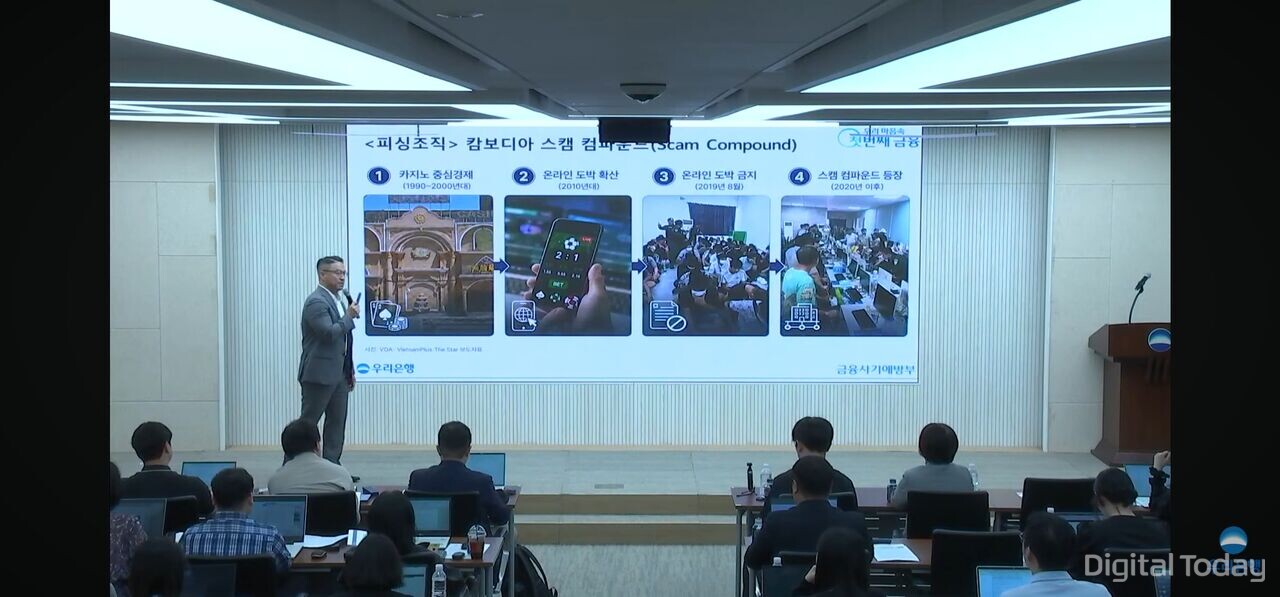
Woori Bank held a press briefing on financial fraud prevention at its headquarters in central Seoul on Oct. 12 and disclosed recent fraud methods, damage-prevention cases and its future response plans. Under the plan, the bank will strengthen its response system centred on a dedicated fraud-prevention organisation, police-trained specialists and its FDS, and expand information-sharing with financial and investigative agencies.
National Police Agency statistics show losses from financial fraud in South Korea rose nearly threefold in three years, from 791.1 billion won in 2022 to 2.38 trillion won in 2025. Woori Bank analysed that crime methods are changing, with smartphones and social media and messengers now combined with generative AI, and with functions such as technology development, luring victims, and moving and laundering money divided among different groups.
Woori Bank cited "Pig Butchering" and "Recovery Scam" as methods requiring caution. Pig butchering is a method in which scammers build trust over a long period through social media or messengers, then induce victims to gradually increase investment amounts and block withdrawals. A recovery scam is a secondary fraud in which scammers approach existing victims by impersonating investigative agencies or experts, then demand additional fees or taxes on the pretext of recovering losses.
Woori Bank is shifting its financial fraud response from reliance on individual employees' judgement to an organisation-level, always-on prevention system. It created a dedicated financial fraud prevention department and recruited a police-trained financial fraud expert for the first time in the banking sector. Jae-hong Jeon (전재홍), senior head of the Financial Fraud Prevention Department who made the presentation, worked in the police for 24 years before retiring as a superintendent and has experience investigating voice phishing groups.
The bank also strengthened coordination between its FDS and anti-money laundering (AML) department. From April to August this year, the FDS delivered 639 cases of information suspected of money laundering to the AML department, which reported 83 cases as suspicious transactions after further analysis. In the same period, it shared 664 suspicious accounts at other banks with the financial sector through the voice phishing information-sharing analysis AI platform ASAP.
The bank also disclosed cases in which it prevented large losses in advance through its FDS. It prevented losses of 260 million won by confirming inconsistencies in statements between a customer and a related party, and blocked a transfer of 80 million won by identifying an account reported for investment fraud through information-sharing with another bank. It also detected a transaction in which a customer was attempting to buy gold with a 180 million won loan under instructions from someone impersonating prosecutors, preventing further damage.
Going forward, the next-generation FDS will link not only existing financial transaction information but also electronic finance FDS and login information, product usage information and ASAP risk-account information. Generative AI will analyse new fraud patterns and unusual signs and support the establishment of new detection scenarios and policies. Woori Bank plans to launch the system in November and carry out stabilisation work through year-end.
Woori Bank CEO Jin-wan Jeong (정진완) said, "We will further strengthen a prevention system that does not stop at providing relief after damage occurs, but detects risk signs a step earlier and blocks them before customers' funds are handed over to fraudsters."
 Ji-young Lee
ljy@d-today.co.kr
Ji-young Lee
ljy@d-today.co.kr