
AI-native security platform company AhnLab said on Sunday it built a security system at the National Research Foundation of Korea to enable the use of generative AI and the internet within its work network under the Korea Internet & Security Agency’s 2026 National Network Security Framework (N2SF) deployment support project.
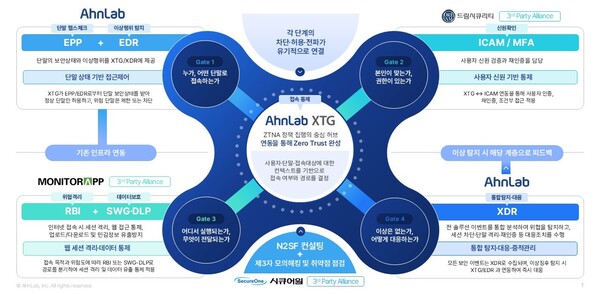
AhnLab, the lead company of the consortium for the Korea Internet & Security Agency’s 2026 N2SF deployment support project, has supported the foundation’s N2SF rollout since June by forming a consortium with MoniterLab, Dream Security and SecureOne, among others.
It has completed the configuration and integration of security solutions. It plans to expand the scope to the entire organization from late October to November and complete the build by the end of November.
The build focuses on applying together information service Model 2, which uses generative AI on the work network, and Model 4, which uses the internet on work terminals.
AhnLab explained it supplemented and linked required functions to the foundation’s existing security infrastructure so users can use approved external services on work terminals without switching to an internet-only PC. To do so, AhnLab first linked user authentication, device verification, web isolation and data protection functions between work terminals and external services to implement the security controls required by the two models.
It verifies users’ identities and permissions and the security status of terminals so they can connect only to approved services, while external web content runs in an isolated environment. AhnLab stressed this can block unauthorized access and reduce terminals’ exposure to threats from external web content.
For data transfers, information is classified as confidential (C), sensitive (S) or open (O), and the N2SF principle of differentiated controls by information grade was applied to decide whether to transfer based on the access target and file grade. For example, only O-grade files are allowed for approved O-grade generative AI services and internet sites, while approved S-grade business information systems allow S- and O-grade files under policy but block C-grade files. AhnLab explained this supports the use of information needed for work while blocking transfers that exceed permitted scope.
Baek Min-kyung (백민경), a team leader at AhnLab’s Solution Consulting Division, said the project focuses on applying security controls that protect work information by information grade while using generative AI and the internet in line with the foundation’s work environment. She said AhnLab will proceed with expanded application and inspections by leveraging each consortium participant’s strengths, and complete the build stably so the experience accumulated in the project can lead to the adoption and spread of N2SF across various institutions.
 Chi-gyu Hwang
delight@d-today.co.kr
Chi-gyu Hwang
delight@d-today.co.kr