
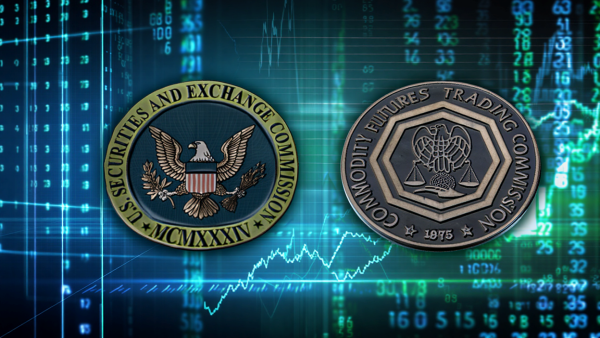
After the Clarity Act stalled in the Senate, U.S. financial authorities are setting rules on their own without waiting for legislation. The SEC and the CFTC on Oct. 5 issued a joint interpretation that, in principle, treats six cryptocurrencies including bitcoin, ether and XRP as assets rather than securities. The SEC also approved listings of six 3-times leveraged ETFs.
Bitcoin recovered to around $86,000 on a weekly closing basis, while XRP drew the most attention ahead of Evernode's Nasdaq listing. Still, an assessment said it was too early to be optimistic as long-term U.S. yields are high and a late-October FOMC meeting remains ahead.
• U.S. SEC, CFTC issue joint interpretation: bitcoin, ether and XRP are in principle not securities • U.S. SEC approves listings of six 3-times leveraged ETFs tied to assets including bitcoin • U.S. Senate introduces crypto tax bill, proposes making stablecoin payments tax-free • Clarity bill stalled but things got better? Four unexpected benefits cited by Bitwise
CFTC Commissioner Michael Selig (마이클 셀리그) on Oct. 5 disclosed the joint SEC-CFTC interpretation at a symposium at Fordham University School of Law in New York. Authorities effectively drew a line in a long-running industry dispute over whether tokens are securities or commodities. Exchanges are split into three tiers. Spot exchanges are centred on state money-transmitter rules, while exchanges offering margin, leverage and lending will be subject to new federal regulation, and derivatives exchanges such as perpetual futures will form a separate tier. Listings must show vulnerability to price manipulation, and commingling customer assets triggers a proof-of-reserves obligation. The comment period runs for 60 days after publication in the Federal Register. As an interpretation rather than a law, it could change with a change in administration, but it signals a shift in regulatory direction from bans to systemisation.
The commodities market also opened up. The SEC on Oct. 3 local time approved a Cboe BZX rule change, allowing listings of six 3-times leveraged ETFs based on bitcoin, ether, gold, silver, crude oil and natural gas. The sponsor is Volatility Shares, and the products use futures to track three times the underlying asset's daily move. Additional registration effectiveness steps are needed before actual trading, and the structure resets returns daily, making it unsuitable for long-term holding.
On the legislative front, Senator Steve Daines (스티브 데인스) introduced the ADAPT Act on Sept. 30. It would not impose capital gains tax when paying for goods and services with dollar-denominated stablecoins, and it would not treat network fees of $10 or less per transaction as gains or losses. Instead, it extends wash-sale rules applied to stocks to cryptocurrencies. Coinbase and Fidelity, among others, expressed support. Bitwise assessed that after the Clarity bill failed, the market instead got better rules faster, but added there is a risk the stance could change when a new administration takes office in 2029.
• Bitcoin breaks above $86,000, could October open the door to a bull market • Bitcoin, ether shake off first-half slump; what conditions are needed for a fourth-quarter rally? • Saylor hints at more bitcoin buying; Strategy holdings at 847,666 BTC
Bitcoin ended the week at $86,532 on Bitstamp, the highest weekly close since late January. Short-position liquidations topped $120 million, adding momentum, and the market is targeting a renewed push for $87,000. Rekt Capital saw the price trapped between support at $82,500 and resistance at $86,700. A break above resistance could open the way to $93,700, but if support breaks it could retest the $60,000 to $80,000 range. U.S. 10-year and 30-year Treasury yields rose to 5.34 percent and 5.69 percent, cited as the highest levels since 2002. Still, an interpretation emerged that the chance of further rate hikes has fallen after September new jobs came in at 29,000, well below the expected 90,000.
The third quarter was strong. Bitcoin rose 42.71 percent and ether gained 70.8 percent, while spot ETFs saw net inflows of $6.49 billion and $3.11 billion, respectively. But Glassnode said trading volume is not keeping up without broad market participation. Heavy sell orders in Binance's spot market are also a burden. The market sees the Oct. 27-28 FOMC meeting as the biggest turning point. There was also a topic of interest. A 4chan user who became famous for calling last year's high pointed to Oct. 5, 364 days after the all-time high of $126,198, as a low, and the price did rebound. Still, it is likely a coincidence and hard to use as an investment basis.
Strategy Chairman Michael Saylor (마이클 세일러) hinted at additional purchases, saying it was "more orange than ever." Holdings stand at 847,666 BTC, about 4.04 percent of supply, with an average purchase price of $75,442 and unrealised gains topping $8.25 billion. The exact scale will be confirmed through SEC filings.
• Evernode, dubbed an 'XRP whale', in final countdown to Nasdaq listing; ticker XRPN • Can XRP reach $2? How Evernode's Nasdaq listing could affect the price • XRP beats bitcoin to rank No. 1 in South Korean trading volume; a cautious view on price impact
Evernode's merger with SPAC Armada II won shareholder approval on Sept. 30, and it will begin trading on Nasdaq as XRPN on Oct. 8. It holds 473 million XRP, the largest amount among listed companies, and more than $1 billion has flowed in with participation from Ripple, SBI Group, Pantera and Kraken. It plans not as a simple passive product but to deploy XRP directly in DeFi and arbitrage. Analysts say XRP could test $2 as circulating supply declines, but profit-taking right after the listing is a variable.
This week, tied to the "XRP Seoul 2026" event, XRP rose to No. 1 in domestic trading volume. But a cautious view also emerged that this reflected a spot-focused structure that blocks leveraged trading, and that adoption of blockchain by the financial sector remains at a proof-of-concept stage in 2027.
• Overseas digital-asset transfers will also be recorded as government tightens tracking of cross-border transactions
The government will centrally manage records of digital assets moving to overseas exchanges or personal wallets through the Bank of Korea's foreign exchange data network. The measure aims to prevent circumvention of foreign exchange rules and illegal transactions using cross-border digital-asset transfers. The government plans to use the overhaul to monitor cross-border transfer information in an integrated way and to identify foreign-exchange rule evasion or illegal trading more quickly.
• From issuance to distribution and payments, tokenised securities partnerships accelerate • Tokenised securities OTC trading capped at 100 million won a year; issuance also allowed for stocks, bonds and funds
With the rollout of a tokenised securities regime about 4 months away, partnerships among South Korean financial firms are accelerating. Rather than securities firms building infrastructure alone, they are dividing roles with blockchain and tokenisation specialists as well as platform and content companies to secure a business base linking issuance, distribution and settlement.
Ahead of the tokenised securities regime set for February next year, financial authorities set the investment cap for retail investors at OTC exchanges at annual net purchases of 100 million won per exchange. The issuance scope for tokenised securities will expand from fractional investment securities to existing securities such as stocks, bonds and funds.
• Money crowds into 'digital dollar' stablecoins, shaking banks and national monetary systems • Porsche 911 NFT Web3 project ends, halts community operations
An analysis said stablecoins allow 24-hour, real-time transfers, which can speed up the outflow of money from bank deposits and domestic currencies during financial instability. During the March 2023 collapse of Silicon Valley Bank, $3.3 billion of USDC reserves was trapped, shaking its value, and in Argentina, 94 percent of crypto bought with pesos was in stablecoins. A counterargument says companies use them only as a settlement tool and convert them immediately into fiat currency. A full-reserve asset regulatory proposal released by the Fed last week, a follow-up step ahead of the January 2027 implementation of the Genius Act, would require issued tokens to be backed 100 percent by short-term Treasuries and other assets. As regulation tightens, debate has also grown over where risk could spread. The Ethereum Foundation applied "zkAPI" to its mainnet, enabling anonymous payments of AI service fees using zero-knowledge proofs.
Porsche, meanwhile, shut down its 911 NFT Web3 project. Issuance totalled 2,363, below the 7,500 target, and trading value over the past month amounted to just $2,900. In a market where regulation is becoming clearer, real-world use and profitability are becoming survival criteria.
 Hyunwoo Choo
cookinpapa@d-today.co.kr
Hyunwoo Choo
cookinpapa@d-today.co.kr