
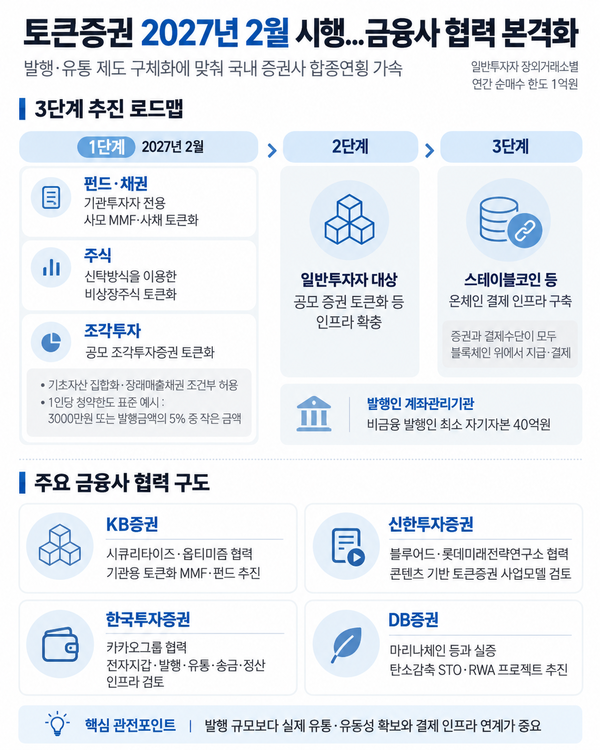
With the tokenised securities system about 4 months away, consolidation and tie-ups among South Korean financial firms are accelerating. Securities firms are splitting roles with blockchain and tokenisation specialists, and platform and content companies, rather than building infrastructure alone, as they seek a business base linking issuance, distribution and payment.
The Financial Services Commission has issued a legislative notice on draft revisions to subordinate regulations under the Electronic Securities Act and the Capital Markets Act related to tokenised securities, from Oct. 2 to Nov. 11. The revised Electronic Securities Act and Capital Markets Act take effect on Feb. 4, 2027. The scope of tokenisation will also expand from fractional investment-focused assets to standardised securities such as stocks, bonds and funds.
An issuer account management institution, which allows an issuer that is not a financial company to manage accounts directly, must meet requirements including at least 4 billion won in minimum capital. On an over-the-counter exchange, the annual net purchase limit for retail investors will be set at 100 million won.
As policy direction moves into detailed rules for the law's implementation, financial firms' preparations are shifting to a stage of concretising business models and infrastructure.
Korea Investment & Securities has expanded its scope of cooperation with Kakao Group beyond tokenised securities to cover digital asset infrastructure overall. Korea Investment & Securities signed a memorandum of understanding on Oct. 1 with Kakao, KakaoBank and Kakao Pay to jointly develop digital asset issuance and distribution services.
They will jointly pursue not only investment, remittance and settlement services, but also building e-wallets, custody of digital assets and links to customer-facing services. It is an expansion to the group level of the stablecoin and tokenised securities distribution cooperation that had previously been reviewed with KakaoBank.
KB Securities partnered last month with Securitize and the Optimism Foundation. Under the arrangement, KB Securities is responsible for underwriting, issuing and selling financial products and for an institutional client base, while Securitize provides tokenisation infrastructure and Optimism provides the blockchain network.
It plans to first pursue tokenised money market funds (MMFs) and funds for institutional investors, and then expand the scope to stocks, American depositary receipts (ADRs), corporate bonds and Korean Treasury bonds.
Shinhan Securities is preparing an investment contract securities and tokenised securities business using content as the underlying asset, together with Blueward and the Lotte Future Strategy Research Institute.
Blueward will be in charge of sourcing underlying assets and detailing the business model, while Shinhan Securities will support account management institution work and issuance and management infrastructure. The Lotte Future Strategy Research Institute will be responsible for finding products that use the group's intellectual property (IP) and content.
DB Securities is focusing on connecting real-world assets (RWA) and tokenised securities to actual business. It has formed a consortium with MarinaChain and others to carry out a "carbon reduction STO platform development and commercialisation project" that links cash flows from carbon-reduction equipment in the shipping sector to tokenised securities.
It also formed a partnership with Optimism in July. More recently, it discussed the possibility of cooperation with global blockchain companies on real-asset tokenisation, joint product development and links to global infrastructure.
There are also cases where issuance has already taken place. Mirae Asset Securities issued digital bonds worth a total of about 100 billion won in January in Hong Kong, including 325 million Hong Kong dollars and $30 million. HSBC served as the lead manager, and the issuance used HSBC's tokenisation platform Orion, linked to the Hong Kong Monetary Authority (HKMA) bond settlement infrastructure.
It is a case of securing issuance experience first by using overseas regulated infrastructure while waiting for the system's implementation in South Korea.
Financial firms are repeatedly joining hands with external companies because the tokenised securities business does not stop at simply issuing a single product. It requires linking multiple functions, from sourcing underlying assets and product design to distributed ledgers, account management, distribution platforms, customer touchpoints and payment networks.
As each financial firm prepares its own ledger or connections to global blockchain networks, competition is emerging over which infrastructure and products can be commercialised first after the system takes effect.
In the early market, relatively simple-structure products such as private-placement MMFs and private bonds for institutional investors are expected to be tokenised first. After market stability and demand are confirmed, the scope could expand to public-offering securities.
Yeonsu Ko (고연수), an analyst at Hana Securities, analysed that "as the tokenised securities market grows, actual trading and securing liquidity will become more important than simple issuance amounts, and after the distribution market expands, settlement infrastructure will be the next task."
In the United States, moves to open the tokenisation market within the existing regulatory framework are continuing separately from congressional legislation. The U.S. Securities and Exchange Commission last month granted a 5-year temporary exemption allowing tokenised U.S.-listed stocks that meet certain conditions to be traded on permitted on-chain trading markets.
Even as the Market Structure Act, known as the Clarity Act, is delayed, the regulator used its existing authority to create a limited space for real-world testing.
Competition among South Korean financial firms is also expected to be determined not by MOUs or proof-of-concept (PoC) efforts themselves, but by whether they can lead to actual products and trading after February 2027.
Hyunil Jang (장현일), chief financial officer (CFO) of DB Securities, said, "What is needed is a demonstration that leads to an actual business, not a showy demo or PoC." He added, "We will link verified results through rapid demonstration to the next stage."
 Sangyeop Oh
yub@d-today.co.kr
Sangyeop Oh
yub@d-today.co.kr