
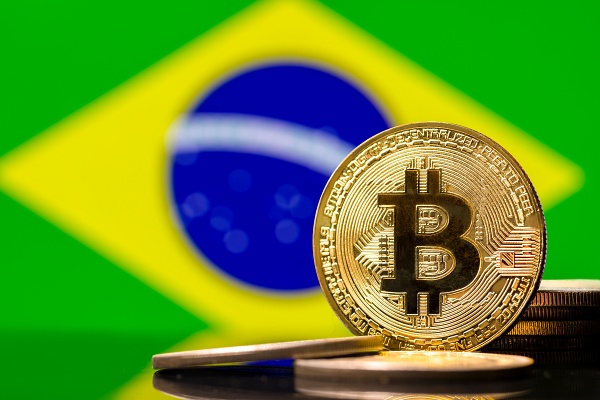
Brazil has ranked first in a revamped cryptocurrency adoption index. As the global crypto market contracts, trading and usage have risen in Latin America, widening adoption gaps by region.
On Sept. 23 local time, blockchain outlet The Defiant reported that Chainalysis assessed crypto adoption by country and ranked Brazil No. 1. The United States was second, Nigeria third, Japan fourth and South Korea fifth.
The index was calculated by combining four factors: fund flows to crypto services, domestic peer-to-peer activity, cross-border fund flows and on-chain holdings. Brazil did not rank first in any single category, but placed second in cross-border fund flows, third in service fund flows and P2P activity, and fourth in on-chain holdings, earning consistently high scores across categories.
Latin America also stood out in regional trends. Chainalysis put the region's crypto activity at $593.8 billion, and said it grew 9.8 percent over the same period, while the global crypto economy shrank 1.6 percent.
Latin America's growth is even more notable compared with the broader market contraction. Chainalysis said that while total crypto market capitalisation fell by about 50 percent, on-chain economic activity slipped only to $9.4 trillion from $9.5 trillion. That highlights a gap between falling prices and actual network use and trading activity.
Brazil's rise to the top is also seen as the result of consistently high activity across several indicators rather than rapid growth in a single area. It ranked highly in cross-border fund flows, P2P trading and use of crypto services, lifting its overall position.
The results show the crypto market downturn is not unfolding the same way across regions. Crypto trading and usage increased in Latin America even as the global market shrank.
Still, the index alone makes it difficult to pinpoint the reasons behind growth in Brazil and Latin America. Chainalysis' rankings are based on actual on-chain activity and fund flows, but they do not directly explain detailed causes such as regulatory changes by country or the background to capital inflows. Attention is on whether the growth is temporary or a structural trend that leads to broader crypto use in the region.
The global crypto economy held up through the bear market. At $9.4 trillion, it retreated just 1.6 percent YoY despite the widespread crypto price collapse. Our latest research explains why. https://t.co/jHdQS2NXHg
 Jinju Hong
hongjj@d-today.co.kr
Jinju Hong
hongjj@d-today.co.kr