
KT is building a high-performance AI network at HD Hyundai Samho's shipyard in Yeongam, South Jeolla province, and will test physical AI technology such as AI welding robots.
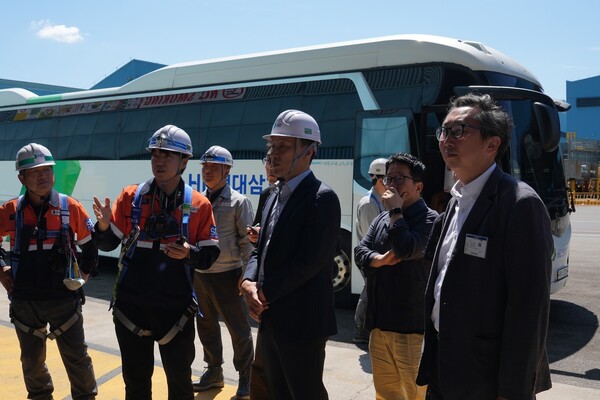
KT said on Sept. 10 it discussed ways to apply physical AI robots at HD Hyundai Samho's shipyard, where an on-site inspection was carried out for the Ministry of Science and ICT's project to build a high-performance AI network.
A high-performance AI network is a next-generation network that uses AI to operate communications networks intelligently and provides the communications and AI computing environment needed for physical AI services. The project is led by the Ministry of Science and ICT and the Korea Intelligent Information Society Agency (NIA). KT was selected in July as the preferred bidder with Samsung Electronics and HD Hyundai Samho, among others.
KT plans to build a high-performance AI network at HD Hyundai Samho's shipyard and, based on it, test physical AI technologies such as AI welding robots. The goal is to link the network, AI and robots to boost productivity and safety at industrial sites. The network to be built at the shipyard will apply 5G standalone (SA) and network slicing, a graphics processing unit (GPU)-based AI computing infrastructure, an AI radio access network (AI-RAN), and autonomous network technology.
During the on-site inspection, it also checked the work process of existing welding robots before applying AI technology. Welding robots are currently operated in a semi-automatic manner, with workers moving them directly and responding to unexpected situations. When AI is applied, the robot will be able to judge work conditions and operate automatically by analysing real-time video and sensor data captured during the work process.
5G SA and network slicing provide the communications resources used by AI welding robots separately from other services. They can stably maintain the communications quality needed for robot control even if data usage at the shipyard increases.
The GPU-based AI computing infrastructure distributes the AI computations required for robots depending on the nature of the work. Tasks that require quick judgement are handled by the robot itself or an on-site server, while large-scale analysis and training are performed at a data centre to improve response speed and computing efficiency. AI-RAN allocates communications capacity and AI computing resources needed by robots depending on work conditions.
Autonomous network technology automatically adjusts communications resources by analysing network traffic and quality information in real time. It detects abnormal situations such as network congestion or quality degradation and maintains communications quality.
Lee Jong-sik (이종식), executive director at KT's Future Network Lab in its network division, said: "Through demonstrations with HD Hyundai Samho, we will verify the technological capabilities of high-performance AI networks and contribute to realising AI infrastructure that boosts productivity and safety at industrial sites."
 Jin-ho Lee
jhlee26@d-today.co.kr
Jin-ho Lee
jhlee26@d-today.co.kr