
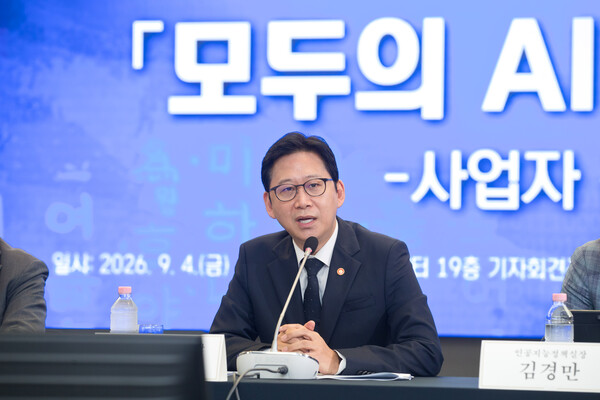
The system under which Bae Gyeong-hun (배경훈), deputy prime minister and minister of science and ICT, effectively shouldered the government's AI policy alone has come to an end. That follows the filling of the presidential office senior secretary for AI future planning and the standing vice chair post at the National AI Strategy Committee. Attention is on whether Bae can ease the burden of coordinating AI policy across government and focus on major projects led by the science ministry, including a homegrown AI model, AI infrastructure and industrial and public AI transition (AX).
With the recent appointment of Lee Hae-min (이해민) as presidential office senior secretary for AI future planning and Ha Jung-woo (하정우) as standing vice chair of the National AI Strategy Committee, the government's AI policy command structure has been reshaped into a three-pronged system again. It means staffing is now in place to take charge of overall AI policy roles at the presidential office and the strategy committee.
AI strategy concentrated in one person, spanning minister, deputy prime minister and strategy committee
Bae has also served as standing vice chair of the National AI Strategy Committee since May. It was to fill a vacancy that arose when former standing vice chair Lim Moon-young stepped down to run in a by-election. Bae personally chaired the strategy committee's steering committee and checked the progress of AI policy across government and the implementation of the "Korea AI Action Plan". Still, criticism emerged that responsibility for drafting and executing AI strategy was overly concentrated in one person, as Bae's roles overlapped as science ministry minister, deputy prime minister for science and technology, and strategy committee vice chair.
In particular, the strategy committee was seen as having weakened presence despite its status as a public-private AI policy consultative body chaired by the president. It should coordinate AI policy across government and present mid- to long-term strategies, but under Bae's dual-role setup the boundary between the science ministry's policy and the strategy committee's role was not clear. An industry official said, "It is true concerns kept coming up about the concentration of work on Deputy Prime Minister Bae," and added, "Hasn't the strategy committee's presence also weakened?"
With the new lineup in place, role-sharing on AI policy is expected to become clearer. Lee is expected to coordinate policies and priorities among ministries from the presidential office, and Ha is expected to flesh out mid- to long-term strategies across government. Bae and the science ministry are expected to put weight on turning those into actual projects and policies.
Within and outside the government and industry, expectations are growing that policy decisions and execution could speed up as the roles of the three organisations become clearer. An AI industry official said, "If the boundary between strategy and execution was somewhat unclear until now, a structure has now been created in which the presidential office, the strategy committee and the science ministry each take on their roles," and added, "If communication among them is smooth, the pace of pushing policies could be faster than before."
Above all, Bae now has room to focus on issues at the science ministry. The number of AI projects the ministry oversees is greater than ever. National core projects are being pursued at the same time, including a homegrown AI foundation model project, securing large-scale graphics processing units (GPUs), building AI computing infrastructure, "Everyone's AI," and industrial and public AX.
The science ministry's AI budget for next year is 9.42 trillion won, up 84.3 percent from this year. It is about one-third of the ministry's total budget. Responsibility has also grown to translate the budget into real results, as much as to design policies.
He also cannot focus only on AI. As deputy prime minister for science and technology, he must coordinate cross-ministry research and development (R&D) policy while also attending to science and technology issues, including aerospace, quantum, semiconductors and the K-Moonshot initiative that the government is pushing as a next-generation growth engine.
With burden eased, Bae now faces a test of execution results
It is also expected to be another test for Bae. He took office in July last year and has already served more than a year. In a cabinet reshuffle late last month that replaced six ministers, Bae was reappointed.
A government official said, "If you have served (as minister) for more than 1 year, you can be seen as having entered the ranks of long-serving ministers," and added, "As you have effectively passed the halfway point of your term, it is time to clearly show policy results so far."
An additional evaluation of the homegrown AI foundation model is scheduled for the end of the year, and "Everyone's AI," a public AI service, has entered a full-scale implementation stage after the selection of an operator. Large-budget projects, including expanding AI computing infrastructure and GPU supply, and industrial and public AX, are also at a stage where they must show real results beyond plans.
Coordination with the new AI policy team is expected to be positive. Bae, a former head of LG AI Research, is known to have frequently exchanged views on AI policy with Ha even before. After news of Ha's appointment became known, Bae also changed his Facebook cover photo to a picture of the two together. Lee is also considered a figure with strong understanding of the science ministry's AI policy, as he has continuously handled AI-related policy and legislation in the National Assembly.
An AI industry official said, "Deputy Prime Minister Bae and Vice Chair Ha have been communicating from before, and Senior Secretary Lee has also continuously handled related policies in the National Assembly," and added, "We do not think it will take a long time for the new lineup to get in sync with each other."
 Jinho Lee
jhlee26@d-today.co.kr
Jinho Lee
jhlee26@d-today.co.kr