
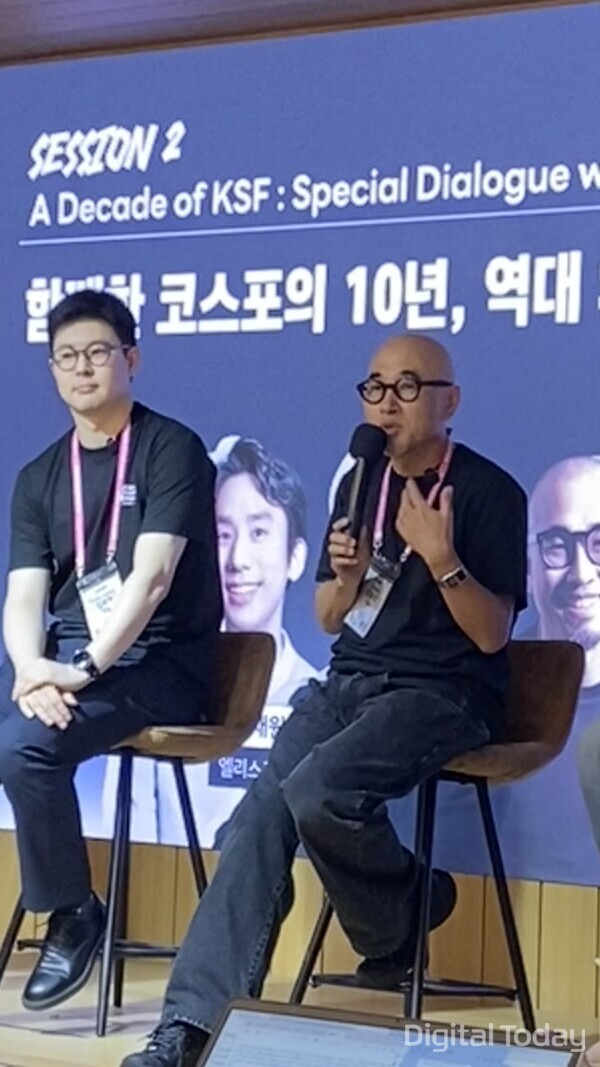
Kim Bong-jin (김봉진), founder of Baemin and the inaugural chair of the Korea Startup Forum (KOSF), said the “Tada incident” left entrepreneurs with a psychological barrier to creating innovative services. Former chairs who gathered to mark the forum’s 10th anniversary called for improving the regulatory environment for startups, including a shift to negative regulation and the creation of a fair competitive market.
In a special talk at the “KOSF 10th Anniversary Media Day” held at Tipstown in Seoul’s Gangnam district on Tuesday, Kim said the Tada case was “a very big shock.” He said it left everyone in the industry with frustration and a sense of loss, and raised doubts about whether innovative companies could keep emerging in South Korea and whether the problem had to be handled so extremely.
The Tada incident refers to the controversy over alleged illegal paid transport involving the 11-seat van-hailing service “Tada Basic” and the subsequent suspension of the service following a legal revision. A court acquitted the defendants in a first trial in February 2020, but Tada Basic halted operations after the so-called “Tada ban law” passed the National Assembly in March that year.
Kim said the regulatory environment also affected entrepreneurs’ choices. He said it was true that events after that created a psychological barrier for founders trying to build innovative services. He said that when he started again, the first thing he discussed with members was to build a company without a public affairs team, and one that did not need such a team. He added that he is now in the consumer goods business after choosing an industry that could avoid regulatory burdens.
Kim recalled that the background to KOSF’s launch also intersected with regulatory issues. As startups such as Callbus ran into various regulations, 20 to 30 founders gathered, and discussions began on forming an organisation out of a sense that small companies would struggle to respond individually, he said.
He said that the fact the association was still talking about regulatory issues even after 10 years seemed to reflect the reality of South Korean society as it is.
The special talk included former KOSF chairs Kim, now CEO of Grande Clip, Park Jae-wook (박재욱), CEO of Socar, and Han Sang-woo (한상우), CEO of Wizdom, along with current chair Kim Jae-won (김재원), CEO of Elice Group. KOSF CEO Choi Ji-young (최지영) moderated.
Park said the regulatory system should be shifted to a negative approach. He said negative regulation that allows everything not specified by law is important, and that it is necessary to freely try anything not stated in law and then create laws and regulations to fit the innovation that follows.
He added that he believes the source of much innovation in countries such as the United States lies in negative regulation, and said he hopes more efforts will be made to turn this into national policy so innovation can happen more often.
Han said startups need a market environment where they can compete freely and fairly.
He said he wants to win in the market and does not want to grow under protection. He said he often encounters situations where the market is neither free nor fair in the process of dealing with large companies or clashing with occupational groups.
He said creating a free and fair competitive market is what the government should do. He said if such a market opens, startups will show a high win rate and it could lead to other startup exits and innovation such as mergers and acquisitions by large companies.
Kim said systems should be improved through continued communication with the government and the National Assembly, rather than avoiding regulatory conflict.
He said these issues are bound to persist because lawmakers must continue legislation and businesspeople must create new things. He said he is instead considering how to communicate better with the National Assembly and the government.
KOSF presented five core tasks for the next 10 years: market, innovation, expansion, growth and legacy. It plans to pursue measures including support for startups’ market entry through expanded initial government purchases and proof-of-concept programmes; a shift to negative regulation that allows in principle and regulates what is necessary; a virtuous cycle of capital and experience through revitalising IPOs, M&A and secondaries and linking with global investment; securing talent by improving stock-based compensation and related laws and tax systems such as stock options and restricted stock units (RSU); and building a “pay it forward” ecosystem that connects the capital and experience of successful founders to younger entrepreneurs.
 Seulgi Son
sageson@d-today.co.kr
Seulgi Son
sageson@d-today.co.kr