
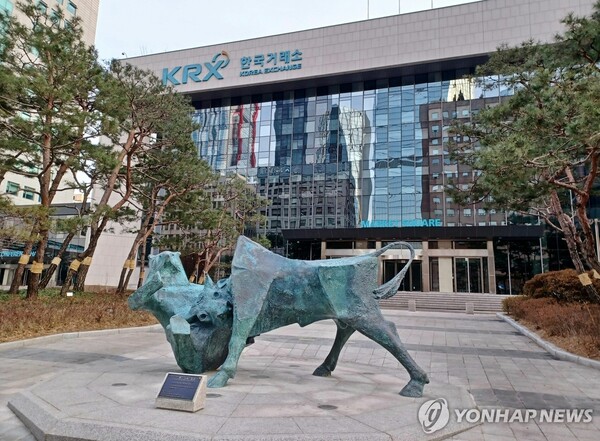
The Korea Exchange (KRX) will operate an after-hours market from Sept. 14 that allows real-time stock trading until 8 p.m. after the close of the regular session. With KRX joining Nextrade (NXT) in opening an after-hours market, competition over trading hours in South Korea’s stock market is expected to intensify.
KRX said on Tuesday it revised relevant rules for its securities and KOSDAQ markets and will run the KRX after-hours market from 4 p.m. to 8 p.m. starting Sept. 14. A total of 38 securities firms plan to participate, accounting for 95.2 percent of market share.
Currently, KRX conducts after-hours trading from 4 p.m. to 6:10 p.m. using a single-price call auction at 10-minute intervals. When the new system takes effect, the existing after-hours single-price trading will be abolished and replaced with continuous matching in which orders from 4 p.m. to 8 p.m. are executed in real time.
As a result, domestic stock trading hours will run from 8 a.m., when the NXT pre-market opens, through regular trading on KRX and NXT, until 8 p.m., when after-hours markets on both venues close. NXT’s after-hours market operates from 3:30 p.m. to 8 p.m., meaning both markets run simultaneously after 4 p.m.
If an investor does not designate a specific market between KRX and an alternative trading system (ATS), the securities firm submits the order to the market that is advantageous to the investor after comparing execution likelihood and price under best execution standards.
Eligible instruments are KOSPI and KOSDAQ-listed stocks and depositary receipts (DR). Excluded are KONEX issues and stocks that did not trade during the day’s regular session, stocks under administration, ultra-low liquidity stocks, and stocks that require market oversight such as those under investment warning or risk designations.
Exchange-traded funds (ETFs) and exchange-traded notes (ETNs) also cannot be traded for the time being. The exchange said it reflected industry concerns that after-hours ETF and ETN trading could increase market volatility amid heightened stock market swings.
It plans to review stability and liquidity in underlying asset markets and then discuss again whether to allow trading.
In the after-hours market, only limit orders, best limit orders and most favorable limit orders are allowed. Orders linked to market prices, such as market orders and conditional limit orders, are restricted for investor protection.
Price limits are the same as in the regular session, applying plus or minus 30 percent from the previous day’s close. A volatility interruption mechanism and short-selling rules also apply as in the regular session. The exchange plans to operate an after-hours-only market-making system for thinly traded stocks.
Stocks traded in the after-hours market settle on T+2, the same as regular-session trades.
The disclosure submission window remains 7:30 a.m. to 6 p.m. This is a measure reflecting concerns about so-called late-night disclosures due to an extension of disclosure hours. Disclosures requiring market-operation measures after 6 p.m. will be released at 8 p.m., after the after-hours market closes.
Even after the disclosure deadline, after-hours trading can be suspended as necessary if delisting-related matters and the like are confirmed.
The exchange had initially pushed a plan to open pre-market and after-hours trading at the same time at the end of June, but decided to introduce the after-hours market first after reflecting industry views. It checked its systems by operating a simulated market for 23 weeks in an environment identical to the actual market.
A KRX official said extended trading hours would allow information that emerges after the close to be reflected in prices quickly, expanding trading opportunities for investors. The official added the exchange expects the move to help raise the competitiveness of the domestic stock market in response to efforts by major U.S. exchanges to extend trading hours.
 Sangyeop Oh
yub@d-today.co.kr
Sangyeop Oh
yub@d-today.co.kr