
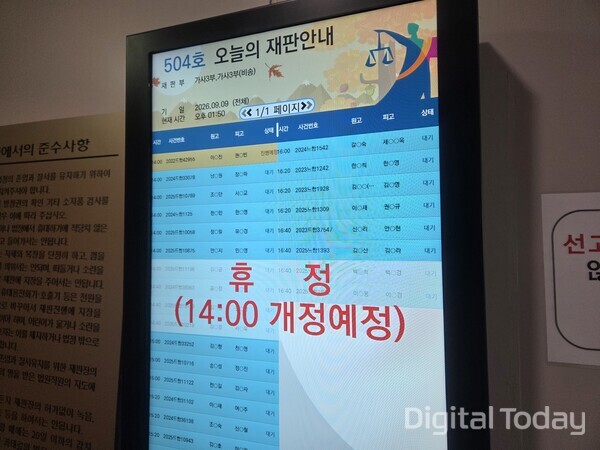
A court accepted at first instance a divorce petition by Smilegate founder and chief vision officer Kwon Hyuk-bin (권혁빈) and his spouse, Lee (이모씨). The court recognised Lee’s contribution to the formation of the couple’s assets at 35 percent and ordered an in-kind division of 35 percent of Smilegate-related shares. It ordered the shortfall of 65 billion won to be paid in cash.
The Seoul Family Court’s Family Division 3 on Sept. 9 ruled that the two should divorce in a lawsuit filed by Lee against Kwon seeking divorce and property division. It came about 4 years after Lee filed the suit in November 2022.
Court: Marriage has broken down; responsibility equal
A key issue in the trial was whether the couple’s marriage had broken down to a degree that made it difficult to restore.
Lee sought a divorce, saying there were serious reasons that made it difficult to continue the marriage. Kwon’s side asked the court to dismiss the claim, arguing the marriage had not broken down and that even if it had, Lee was responsible.
After reviewing the course of the long-running conflict, how it worsened and the possibility of restoring the relationship, the panel found the marriage had broken down beyond repair.
The panel said responsibility for the breakdown lay with both sides and was equal. It found the case fell under Article 840(6) of the Civil Act, which covers other serious reasons that make it difficult to continue a marriage. It accepted the divorce claim and dismissed the claim for consolation money.
Related shares also subject to division; contribution 35 to 65
With the divorce recognised, the court also made a decision on property division.
Issues at trial included whether Smilegate-related shares held by Kwon should be included in the property to be divided, how to value the shares and how to assess each side’s contribution to the formation of assets.
The panel said the shares were assets formed with Lee’s direct and indirect contributions during the marriage. It cited factors including that Lee held some company shares or was registered as a director and representative director during Smilegate’s establishment and growth, and that Lee handled household work and child-rearing for a long period.
It valued the shares using the discounted cash flow method. The panel said intangible asset value has an important effect on corporate valuation for game companies and that future growth potential also needs to be considered. It also found it reasonable to value the company after Smilegate had merged four subsidiaries before the appraisal base date.
It set contributions to asset formation at 35 percent for Lee and 65 percent for Kwon.
The panel said Kwon’s business capabilities and management judgment had a major impact on asset formation in the course of Smilegate’s establishment and management, and recognised a higher contribution for him.
It also considered that Lee was involved in the company’s establishment and growth, handled household work and child-rearing over a long period, and that Lee’s family provided financial support in the early years of the marriage. It reflected in the contribution calculation that Kwon received large dividends from the company after the lawsuit was filed and that in a recent separate case, SmilegateRPG, a former Smilegate subsidiary, was valued higher than the appraisal result in this case.
In-kind split of 35 percent of shares instead of 2.65 trillion won in cash
In the method of property division, an issue was whether to choose a cash payment or an in-kind division of shares.
According to the panel’s explanation, if the entire share corresponding to Lee’s 35 percent contribution were paid in cash, the amount Kwon would have to pay would be about 2.65 trillion won.
But of Kwon’s net assets of about 7.34 trillion won, about 7.00 trillion won was assessed as related shares, accounting for 99.8 percent of the total. The panel said most of Kwon’s assets consisted of unlisted shares, making it difficult to raise large amounts of cash without selling the shares.
It also found that unlisted shares are not easy to sell and that costs and taxes may arise during a sale, so a method of dividing the entire amount in cash is not necessarily appropriate. It also considered that Kwon holds 100 percent of the relevant companies’ shares, so transferring some shares to Lee would not pose a risk of losing corporate control.
The panel ordered an in-kind division of 35 percent of Smilegate-related shares and payment of 65 billion won in cash for the shortfall in Lee’s portion. It also ordered payment of late-payment damages on the 65 billion won calculated at an annual rate of 5 percent from the day after the ruling becomes final until the day the full amount is paid.
It designated Lee as the person with parental authority and custody of the minor child. Kwon must pay child support of 20 million won at the end of each month from this month until the day before the child reaches adulthood. Visitation was to be allowed freely while respecting the child’s wishes. Litigation costs will be borne by each side.
Immediately after the ruling, a representative of Kwon’s side expressed regret over the panel’s conclusion that the marriage had broken down.
A representative of Kwon’s side said, "I have some regret about the panel’s determination that the marriage had broken down." The representative added, "As for the part where the claim for consolation money was dismissed, I understand the panel also determined the defendant had no fault."
On future steps, Kwon’s side said it would decide after reviewing the written ruling. The representative said, "We do not yet know the detailed reasons for the ruling, so we plan to review the written ruling later and decide on future procedures after consulting with the client."
Smilegate said regarding the ruling, "The company has nothing in particular to say about the private affairs of the controlling shareholder," and added, "The company will continue to faithfully carry out its core work as before."
The ruling is at first instance. If either side appeals, the appellate court may again decide on whether to grant the divorce and on the scope and method of property division.
 Ho-jung Lee
lhj@d-today.co.kr
Ho-jung Lee
lhj@d-today.co.kr