
Samsung Electronics is expanding the scope of health management on the Galaxy Watch from individuals to families. If users add a family profile to Samsung Health and link Samsung accounts, guardians or family members can check each other’s health status. The setup allows someone other than the user to notice warning signs first.
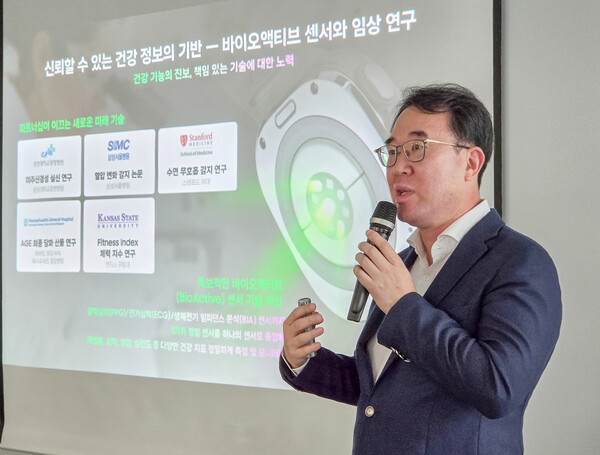
Samsung Electronics introduced Galaxy Watch-based heart health management technology at a media briefing on Tuesday. According to Samsung, the feature lets users choose which health metrics to measure and selectively share. Shareable items include steps, exercise, sleep, weight, body composition, food, heart rate, stress, blood pressure, blood glucose, medication, and vital signs. For example, if a child sees an unusual change in a parent’s shared records, the child can call to check in or recommend a hospital visit.
Samsung Electronics presented a use case ahead of the Chuseok holiday, in which children monitor their parents’ blood pressure and heart rate together. The holiday is one of the few times when families gather and can directly check parents’ health, but after they disperse there is often no clear way to check again.
Accumulated health data is also used in consultations with medical staff. Samsung Electronics said records collected in daily life can be provided as reference material and used to help determine diagnostic and treatment directions.
Samsung Electronics said the tools are particularly useful for early detection of heart disease. At the briefing, it stressed that the Galaxy Watch and Samsung Health help detect subtle physical changes early and prompt immediate action. The premise is that heart disease needs to be caught before symptoms appear to buy time for a response.
The heart health score on the Galaxy Watch Ultra2 and Watch9 combines daily data such as sleep, activity levels, vascular stress and body composition to show a score and practical guidance reflecting long-term heart health. Users whose vascular stress is recorded higher than usual receive messages recommending a low-sodium diet and meals centered on whole grains and fresh foods, described as helping excrete sodium and relax blood vessel walls. The approach goes beyond showing measurements and turns them into directions that can be acted on that day.
The vital signs feature tracks five indicators during sleep: heart rate, heart rate variability, respiratory rate, skin temperature and blood oxygen saturation. An alert appears when a change is detected that deviates from the user’s usual baseline. Family sharing expands the reach of these alerts beyond the user. It creates room for guardians to intervene for users who may struggle to judge abnormal signals on their own, such as elderly parents living alone.
Samsung Electronics added optical heart rate (PPG) sensors to the Galaxy S5, Gear 2 and Gear Fit in 2014, and in 2020 received approval from the Ministry of Food and Drug Safety for the Samsung Health Monitor app as a medical device item to measure blood pressure and electrocardiograms (ECG). In 2021, it installed the BioActive sensor in the Galaxy Watch4, bundling PPG, ECG and bioelectrical impedance analysis (BIA) sensors into a single chipset. Integrating sensors into one chip allows multiple indicators to be measured simultaneously in the limited space of the wrist.
In 2023, the irregular heart rhythm notification feature, which detects and alerts users to possible atrial fibrillation, received approval from the U.S. Food and Drug Administration (FDA) and the Ministry of Food and Drug Safety. With medical device approval, users can use the signal as a basis for seeking hospital care.
According to Samsung Electronics, there have also been cases where the feature helped users get through dangerous moments. Last year, a user in Jordan received a procedure after an irregular heart rhythm notification led to early detection of atherosclerosis. In Brazil, a user who went to a hospital after repeated inconclusive ECG notifications got through a myocardial infarction crisis. There was also a case involving medical staff in South Korea who checked a heart rate on a Galaxy Watch and helped provide first aid during an in-flight emergency. All three cases show a path from measurements taken outside the hospital to medical care.
Choi Jong-min (최종민), an executive director on Samsung Electronics' MX Business digital health team, said the company is supporting preventive management of heart health risk factors in daily life by combining advanced Galaxy Watch sensor technology with Samsung Health’s analytical capabilities. He said it would continue to introduce prevention-focused smart healthcare services.
 Dae-geon Seok
d2dg@d-today.co.kr
Dae-geon Seok
d2dg@d-today.co.kr