
[Digital Today reporter Seulgi Son] OpenAI is preparing to introduce “inference residency” in South Korea, processing AI inference computing for Korean users at domestic data centres. To do so, it is discussing securing GPUs and cloud infrastructure with several local infrastructure providers.
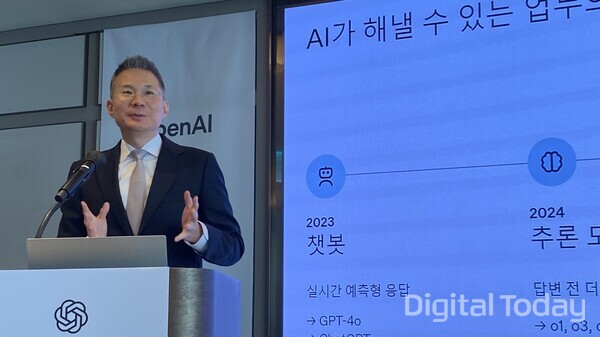
Kim Kyung-hoon (김경훈), head of OpenAI Korea, said at a press briefing marking the first anniversary of OpenAI Korea’s launch, held at Josun Palace Seoul Gangnam in Seoul’s Gangnam district on Tuesday, that some data goes to servers capable of inference during the inference process and the company is preparing to handle that in Korea as well. “It is taking some time because a lot of preparation is needed, but we expect to provide inference residency through domestic data centres in the near future,” he said.
OpenAI currently supports data residency in South Korea. The approach allows data entered by ChatGPT Enterprise, ChatGPT Edu and API customers to be stored domestically. During the inference process, in which the model generates answers, some data can move to overseas computing infrastructure. If inference residency is introduced, that inference computing will also be handled on domestic infrastructure.
The key is securing domestic GPUs and the cloud infrastructure that supports them.
In a question-and-answer session with reporters, Kim said better GPUs are needed to run inference and a cloud system is needed as the foundation that can support GPUs. He said the company is continuing discussions with a few partners in South Korea that can provide such infrastructure.
He added that if new GPUs are brought into one of them, the company expects that portion to be allocated to its inference side. “If this becomes more concrete, I think we will be able to tell you the date,” he said.
Limited GPUs and the resulting costs are expected to be a factor in companies’ decisions on whether to use domestic inference. Kim said companies will consider pricing because GPUs are limited. He said they will decide together with costs whether local inference is really needed. The company’s policy is to provide it to customers that need domestic inference, without limiting the target to specific industries or customer groups.
OpenAI Korea said after launching on Sept. 10 last year, AI use by domestic companies has been increasing rapidly. Domestic ChatGPT Enterprise users rose 28-fold over the past year, and overall ChatGPT users increased 35 percent over the same period. Users of ChatGPT Work and Codex rose 14-fold over six months compared with March 1 this year.
Kim said companies previously remained at the level of providing information inside the company in chatbot form, but now the company is seeing them build teams with AI to create new products and services. He said Codex use is also spreading beyond engineers to non-development roles such as legal, finance, human resources, accounting, marketing and sales.
Domestic AI adoption cases that OpenAI disclosed on Tuesday included Samsung Electronics, Samsung SDS, LG Electronics, LG Uplus, LG CNS, SK, Krafton, Kakao, Tving, Musinsa, Nexen Tire, Toss, Korea Zinc, HanaTour, Yanolja, GS Engineering & Construction and law firm Bae, Kim & Lee (BKL). OpenAI said AI adoption has spread across industries including manufacturing, finance, technology, telecommunications, content, commerce, professional services and construction.
As a representative case, Samsung Electronics is using OpenAI products across multiple areas including research and development, marketing, overseas sales and production management. OpenAI assessed the Samsung Electronics case as one of the largest corporate deployments globally. At Seoul National University, about 50,000 faculty, staff and students are also using ChatGPT and Codex for research and development and work.
It is also expanding its domestic partner ecosystem. OpenAI is cooperating with Samsung SDS, LG CNS and SK AX in the large systems integration sector, and with MegazoneCloud, Bespin Global and Cloucus in cloud operation and management services. It introduced Koka and Aim Intelligence as AI startup partners. Platform integration via Amazon Bedrock is also under way.
Kim said the office in South Korea is still relatively small, limiting its ability to directly support many companies and small and medium-sized enterprises. He said the company will work with partners that have led AI transformation in South Korea to improve the speed and depth of AI adoption.
 Seulgi Son
sageson@d-today.co.kr
Seulgi Son
sageson@d-today.co.kr