
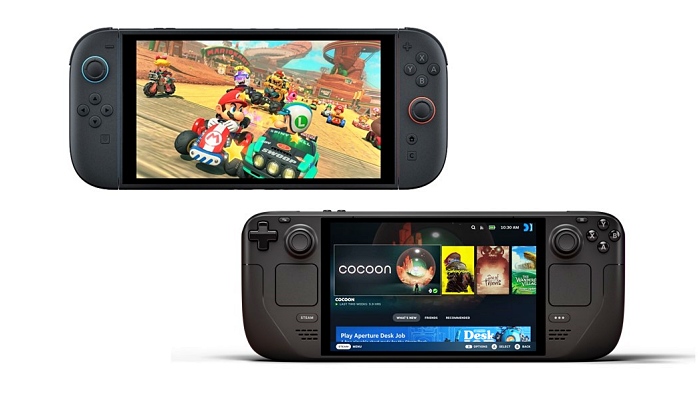
[DigitalToday reporter Jinju Hong (홍진주)] Nintendo's Switch 2 shows graphics performance in handheld mode similar to Valve's Steam Deck, but delivers a big boost when docked, a comparison found. Differences between the two devices stood out more in docking, game optimisation, price and their game ecosystems than in raw hardware performance, IT outlet Engadget reported on Monday.
A comparison of Switch 2 and Steam Deck found Switch 2 does not show a large performance gap in handheld mode, but is rated as sharply improving graphics processing performance when connected to a dock.
Switch 2's handheld-mode GPU performance is about 1.71 TFLOPS, similar to Steam Deck's 1.6 TFLOPS. When docked, performance rises to up to 3.7 TFLOPS. That widens the graphics performance gap with Steam Deck in a docked setup.
That structure translates into an advantage in running games at higher resolutions. Switch 2 supports 4K output in some games, and Engadget cited the ability to play games in 4K when docked as a key advantage of Switch 2.
Switch 2 includes an Nvidia Ampere architecture-based GPU. It also supports rendering games at a lower internal resolution and then using DLSS to improve image quality. That technology is used in actual games. 'Metroid Prime 4' can run at 4K resolution and 60 frames per second, and 'Cyberpunk 2077' was assessed as supporting 1080p output when docked. Using more than 1,500 CUDA cores, some games including 'Star Wars Outlaws' can also process ray tracing.
Steam Deck, by contrast, does not see a rise in graphics performance when docked. Steam Deck, which includes an AMD RDNA 2-based GPU, was introduced as having performance capable of running 'Elden Ring' at about 720p and 30 frames per second. It supports ray tracing itself, but without dedicated CUDA cores, enabling it is assessed to cause a significant performance drop.
Steam Deck is relatively ahead in CPU and memory. It has an AMD Zen 2-based four-core processor and supports clock speeds of up to 3.5 GHz. Switch 2 uses an ARM Cortex-A78C-based eight-core processor, but its typical operating speed is about 1.1 GHz.
Even so, Switch 2's processor is based on a newer architecture and is assessed as delivering performance competitive with Steam Deck despite the lower clock speed. Steam Deck uses 16 GB of unified memory, while Switch 2 has 12 GB.
In actual games, optimisation differences matter more than hardware specifications. Switch 2 is based on a single fixed hardware platform, making it easier for game developers to optimise toward a specific performance target. Steam Deck also has a fixed hardware configuration but is built on the PC game ecosystem. For newer games, there are many cases where graphics options must be lowered to secure stable frame rates. Steam's 'Steam Deck Verified' is used as a standard to judge whether a game runs smoothly without major separate settings changes.
On price, Switch 2 has an advantage. After Steam Deck prices were raised by up to $300, the 512 GB OLED model sells for $789 and the 1 TB model for $949. Switch 2 is priced at $499, making it relatively cheaper on hardware price alone.
The picture changes when game purchase costs are considered. Steam regularly runs large-scale discounts, allowing Steam Deck users to expand their game libraries at relatively low prices. Nintendo eShop also runs discount events, but price cuts for major exclusive games are relatively smaller. As of the time of the article, 'Mario Kart World' was selling for $79.
Differences are also clear depending on how the devices are used. Switch 2 can be easily switched to a TV screen when the main unit is connected to the dock, giving it an advantage as a hybrid game console that moves between living-room and handheld use. Steam Deck can also connect to a larger screen with a separate $79 dock, but Switch 2 was assessed as more intuitive in terms of home-screen navigation and TV connection convenience.
As a pure handheld game console, Steam Deck's OLED screen is a strength. Steam Deck currently on sale is the OLED model, and while Switch 2 offers a larger 1080p screen, it uses an LCD panel. Steam Deck OLED was assessed as ahead on display quality, including colour and contrast.
Ultimately, choosing between the two products depends less on absolute performance than on how users want to enjoy games. Switch 2 is favourable for those who value Nintendo-exclusive games and play that moves between TV and handheld modes. Conversely, Steam Deck is better suited for those who want to enjoy a wide PC game library, including older titles and indie games, at low prices. In particular, taking game discount benefits into account could increase Steam Deck's competitiveness in long-term game costs.
 Jinju Hong
hongjj@d-today.co.kr
Jinju Hong
hongjj@d-today.co.kr