
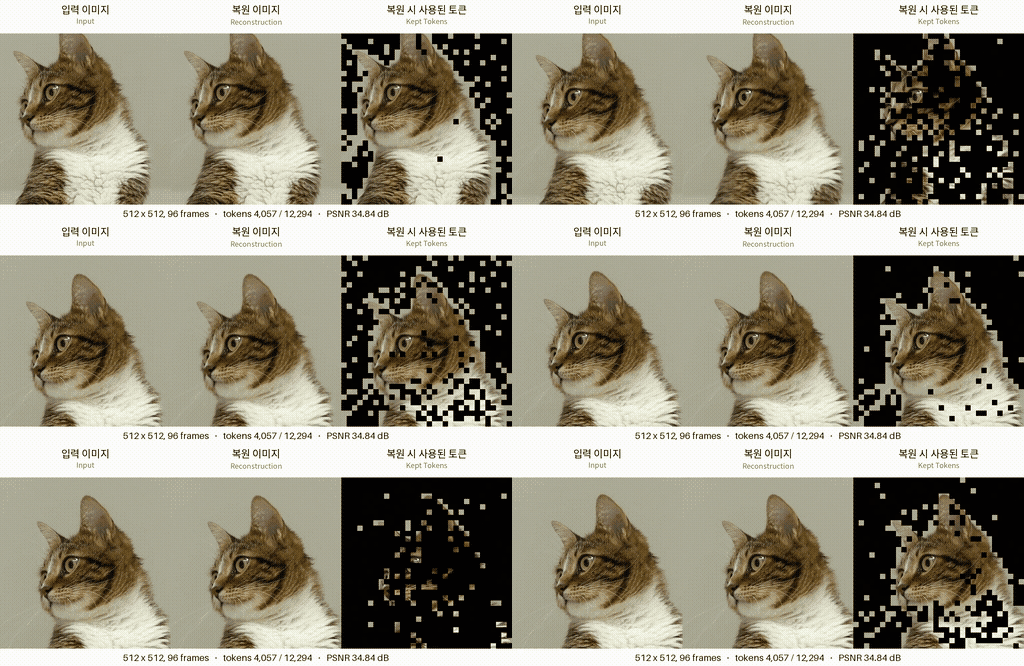
Kakao is unveiling a technology that reduces computation needed for video generation by adjusting the number of tokens AI requires depending on a video's complexity. In experiments, it increased training speed for a video generation model by about 6.9 times and generation speed by about 3.2 times compared with existing methods.
Kakao said on Tuesday it will present an adaptive video tokenisation technology, KATok (Keep-or-Drop? Adaptive Tokenizer for Compact Video Representation), at the European Conference on Computer Vision (ECCV) 2026, an international conference in computer vision.
ECCV is considered one of the world's three major computer vision conferences, along with the Conference on Computer Vision and Pattern Recognition (CVPR) and the International Conference on Computer Vision (ICCV). This year's event runs in Sweden through Sept. 12, and Yeon-kyung Lee (이연경), a Kakao research engineer who led the study, will present the paper on Wednesday local time.
KATok automatically adjusts the number of tokens AI uses for computation depending on a video's motion and information content. It allocates more tokens to scenes with more motion or higher information content and reduces redundant tokens in static areas.
Existing video tokenisation methods compress data at a fixed ratio regardless of video content, generating the same level of tokens even for scenes with little motion. As video resolution rises and clips get longer, the need to process unnecessary tokens increases computation, creating a problem.
Kakao focused on reducing duplicated data between video frames to ease that computational burden. It was designed so that AI determines the required computation based on spatiotemporal complexity without separately specifying the number of tokens.
Tests showed KATok reconstructed video using fewer tokens than an existing dense tokenizer. When applied across the full video generation process, training speed for a video generation model improved by about 6.9 times and video generation processing speed rose by about 3.2 times.
Kakao said it improved computational efficiency for the entire generation process by linking the approach not only to the token compression stage but also to the video generation model. It plans to further develop KATok and apply it to higher-resolution and longer-duration video generation environments.
Dong-jin Choi (최동진), performance leader for Kakao Applied AI models, said KATok's computation-saving effect would be larger in environments where computation increases, such as high-resolution and long-duration video. He said Kakao plans to verify its general applicability across various AI video generation models and develop it into a large-scale video generation core technology.
 Ho-jung Lee
lhj@d-today.co.kr
Ho-jung Lee
lhj@d-today.co.kr