
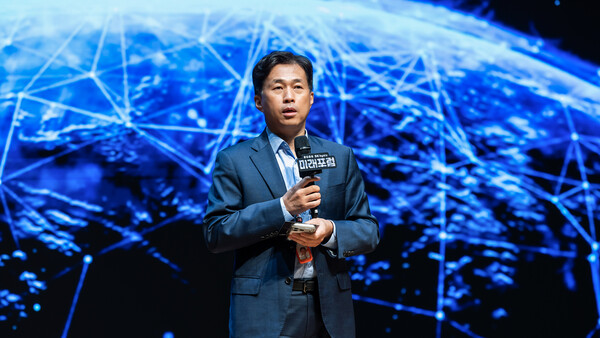
The benchmark in memory competition is shifting from capacity and speed to system design capabilities. SK Hynix on Tuesday presented a 'Full-Stack AI Memory' strategy at the '2026 SK Hynix Future Forum' held at the Supex Center on its Icheon campus.
The company is seeking to move beyond being a supplier of memory devices to becoming a company that understands and co-designs AI systems. The core of the strategy is combination and collaboration. Vice President Lim Eui-cheol (임의철) described bundling different memories such as 3D-stacked DRAM, HBM and HBF to match workload characteristics. Another pillar is pursuing 'system-level co-design' with ecosystem partners including AI services, software and accelerators. SK Hynix laid out a direction to evolve into a 'full stack AI memory creator.'
The shift is driven by changes in workloads. As AI moves to agentic AI that sets goals and executes tasks on its own, the amount of state information that AI must remember and manage has increased. With varying lifespans and access characteristics, a single general-purpose memory is difficult to handle. As multi-agent and long-running execution expand, new bottlenecks have also emerged in capacity and bandwidth.
As a technical solution, executives pointed to 3D. Vice Presidents Kim Kyung-hoon (김경훈) and Son Ho-young (손호영) divided 3D technology into device integration by stacking devices vertically, and heterogeneous integration by separately manufacturing chips with different functions and binding them into one. The main directions presented were maximizing data bus bandwidth, ultra-short-distance transmission, and using logic foundries for DRAM peripheral circuits.
Kim said, "To implement 3D-stacked DRAM as an actual product, we must solve different technical challenges than before, including heat generation and process difficulty, as well as design optimization."
The company also reviewed implementation challenges. It must solve packaging challenges at the same time, including design and heat, as well as fine interconnects, bonding and process integration. As the boundary between front-end and back-end processes, and even the technological and business boundary between foundries and memory, draws closer, it said co-optimization beyond existing domains is needed. SK Hynix plans to link outcomes from the forum to tasks across its organizations and move them into execution.
Son said, "3D technology is changing even the technical boundary between fabs and packaging," adding, "Along with innovation in advanced packaging technology, it is important to build co-optimization beyond existing domains and a new collaboration system."
 Daegeon Seok
d2dg@d-today.co.kr
Daegeon Seok
d2dg@d-today.co.kr