
With the official launch of national supercomputer No. 6 set for December, the Ministry of Science and ICT is seeking researchers from industry, academia and research institutes.
The ministry and the Korea Institute of Science and Technology Information (KISTI) will begin a user call on Sept. 9 for the 2026 National Supercomputer No. 6 Innovation Support Programme for researchers who will use the system’s ultra-high-performance computing resources.
As a research paradigm centred on AI spreads, the importance of high-performance computing infrastructure to support it has grown. Domestic researchers in industry, academia and research institutes have faced cost burdens and research security issues by individually buying expensive graphics processing units (GPUs) or relying on private cloud services.
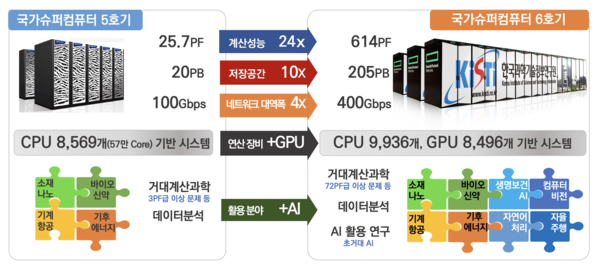
Supercomputer No. 6 is a core national scientific infrastructure to be used for large-scale computational science and data simulation and for AI-based scientific research. It is equipped with 8,496 of the latest GPUs, including Nvidia’s GH200, and 9,936 central processing units (CPUs). Its theoretical computing performance is 614PF, storage capacity is 205PB and network performance is at least 400Gbps.
Compared with supercomputer No. 5, its theoretical computing performance is 24 times higher, storage capacity is 10 times higher and network performance is 4 times higher. The ministry expects No. 6 to be listed as a top-10 class supercomputer globally, considering the latest TOP500 ranking of global supercomputers.
The government signed a contract in May last year with Hewlett Packard Enterprise (HPE) to build supercomputer No. 6. It completed system installation and basic checks in August and is currently conducting performance and stability tests. The target for the official start of service is December.
◆ National strategy, R&D innovation and industrial innovation programmes to be operated
Computing resources for supercomputer No. 6 will be allocated across three programmes: national strategy, R&D innovation and industrial innovation.
About 30 percent of total resources will be allocated to the national strategy programme. It targets national-level projects with high urgency and importance, including tasks to secure national strategic technologies. Resources will be provided on a priority basis to key projects such as K-Moonshot and the seven SEED initiatives. About 55 percent of total resources will be allocated to the R&D innovation programme. It will support general researchers in industry, academia and research institutes with computing resources needed for research and development.
For “large-scale research” requiring ultra-large simulations and ultra-parallel computing, resources equivalent to 50 nodes will be supported. For “creative research” supporting computational science and AI-based research of general scale, resources equivalent to 2 to 49 nodes will be provided.
A new “exploratory research” track will also be created for early validation of ideas. Under this approach, resources equivalent to 1 node will be provided after minimal review. One node of supercomputer No. 6 consists of 4 GH200 units. An industrial innovation programme for industry researchers will also be established.
◆ Official user applications from Sept. 28; pilot service in October
Applications for official service will be accepted on the National Supercomputing Center website from Sept. 28 to 6 p.m. on Oct. 16. Selected users, chosen through a document review and an evaluation committee’s screening, are expected to be allocated computing resources from December.
A pilot service will also be offered ahead of the official service. Researchers who want to use the pilot service can apply from Sept. 23 to Oct. 8. Selected researchers will be able to use supercomputer No. 6 from late October to mid-November.
Kim Sung-soo (김성수), director general for R&D Policy at the Ministry of Science and ICT, said, “Supercomputer No. 6 is core infrastructure that will lead a major leap in science and technology research productivity in the AI era.” He added, “I hope it will produce outcomes that contribute to securing national strategic technologies, including K-Moonshot and the seven SEED initiatives, and to research innovation across industry, academia and research institutes.”
 Jin-ho Lee
jhlee26@d-today.co.kr
Jin-ho Lee
jhlee26@d-today.co.kr