
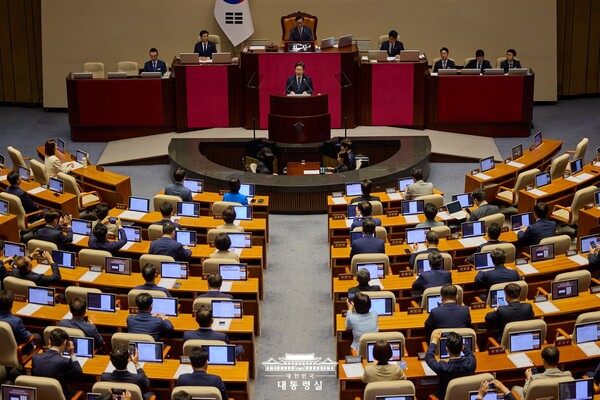
South Korea's ruling and opposition parties are expected to begin a tug-of-war in the September regular parliamentary session over the allocation of funds by sector, as the government's finances expand sharply next year on a semiconductor export boom.
The government's 2027 budget bill, approved at a cabinet meeting on Sept. 1, shows total spending of 820.9 trillion won, up 12.8 percent from the 2026 main budget. It is the first main budget for which the current administration oversaw the entire drafting process. Total revenue rises 30.4 percent to 880.8 trillion won, driven largely by an increase in national tax revenue to 584.4 trillion won from 390.2 trillion won, up 194.2 trillion won. The Ministry of Economy and Finance cited higher corporate and income taxes due to strong semiconductor performance.
What lifted tax revenue was semiconductor exports. The Ministry of Trade, Industry and Energy said semiconductor exports through August this year totalled $281.2 billion, accounting for 40.6 percent of total exports. That is about 2.7 times the level in the same period a year earlier. The extra tax revenue flowed into budgets supporting semiconductors and artificial intelligence (AI). Funding for the so-called "three mega projects plus AI" package, which bundles semiconductors, physical AI and AI data centres, rose 97.2 percent to 21.3 trillion won from 10.8 trillion won.
A semiconductor special account that earmarks funds for semiconductor support will also be created in 2027. Its total size is 2.6 trillion won, including 2.1 trillion won under the Ministry of Trade, Industry and Energy. The ministry's overall budget bill rose 40.5 percent from a year earlier to 13,257,300,000,000 won, the largest since the ministry was launched, including the energy sector.
Three key semiconductor issues for the regular parliamentary session: tax credits, infrastructure and working hours
Money is being channelled toward regions and infrastructure. The Industry Ministry newly allocated 1.5 trillion won for creating a semiconductor cluster in the southwest. That equals 71 percent of the ministry's share of the semiconductor special account and is the largest new project by amount in the budget bill. In the Seoul metropolitan area, 100,000,000,000 won will go to infrastructure to support early operation of fabs in Yongin and Pyeongtaek. By contrast, the semiconductor research and development (R&D) budget fell 5.2 percent to 49.44 trillion won from 52.155 trillion won. That effectively shifts support away from technology development and toward production foundations and regional placement.
A newly raised tax issue is a domestic production tax credit. Tax credits for semiconductor facility and R&D investment, known as the K-Chips Act, passed the National Assembly in February last year. The credit rate rose to 20 percent for large companies, and the semiconductor R&D credit was extended by seven years. The latest tax revision plan adds a new system through 2036 that grants tax credits based on production volume if six sectors - solar power, secondary batteries, semiconductors, core materials and AI robot parts - are produced and sold domestically. It expanded tax support that had been concentrated at the investment stage to the production stage.
State funding for infrastructure in the Yongin mega cluster is also an issue. The government and the ruling party want to sharply raise the state subsidy rate for essential infrastructure construction costs, including power grids and water, to support early operation of the cluster. The opposition party and fiscal authorities view state support for infrastructure for manufacturing lines at profitable large companies as running counter to fairness with general manufacturing and provincial industrial complexes. Costs for building transmission networks to bring power from Honam and the east coast to Yongin, and local compensation, are also points of disagreement in the review process.
A special bill on mega special zones, which bundles these funding and regulations, has been placed as the top priority task for the regular parliamentary session. The bill offers package support in fiscal, financial, tax and infrastructure measures and shortens permitting and environmental impact assessments. The Democratic Party is pushing it as its top legislative priority. Democratic Party leader Kim Min-seok (김민석) defined the three mega projects as "reviving regions by expanding from Honam to Chungcheong and Yeongnam" in a floor speech by leaders of negotiating groups on Sept. 7, signalling passage.
A flashpoint in the bill is an exception to the 52-hour workweek cap, the so-called white-collar exemption. If workers agree, it would not apply the 52-hour weekly cap to the top 3 percent of income earners among managers and R&D staff. It would provide separate allowances instead of overtime, night and holiday pay.
The Industry Ministry supports it, saying intensive inputs are needed for chip design and process development. The Ministry of Employment and Labor and labour groups are sceptical, citing concerns about long working hours. Cheong Wa Dae is also weighing the issue, saying "consent from labour and regions is a prerequisite". The Democratic Party plans to accelerate the process this month by introducing the bill as a lawmaker-sponsored measure in the National Policy Committee rather than the Industry, SMEs and Energy Committee, whose chair belongs to the People Power Party.
A permanent framework for such support is already in place. The Special Act on Strengthening and Supporting the Competitiveness of the Semiconductor Industry, which took effect on Aug. 11, includes the basis for a special committee under the president, a five-year master plan and a semiconductor special account to be operated through 2036. Budget and tax discussions in the regular parliamentary session are the stage of setting the size and conditions of the money to be placed within this framework.
The key point is that the debate relies on strong tax revenue. The National Assembly Budget Office judged that the current growth trend will lead to expanded tax revenue and a lower government debt ratio, easing fiscal burdens. It said growth is concentrated in some export companies, meaning it will take time and policy support for results to spread across the broader economy. With a structure in which tax revenue earned by semiconductors flows back into semiconductors, how far the ruling and opposition parties agree on the size and allocation will be what to watch in the regular parliamentary session.
 Suk Dae-geon
d2dg@d-today.co.kr
Suk Dae-geon
d2dg@d-today.co.kr