
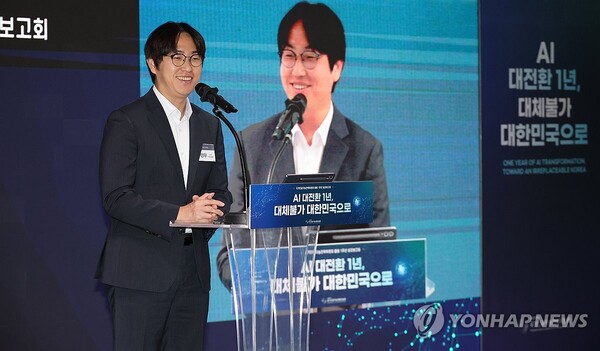
South Korea's National AI Strategy Committee, entering its second year, set a goal of raising the country to an "irreplaceable core nation in the global AI supply chain" and a "trusted partner nation". To that end, it will push implementation tasks including national strategic industrialisation of AI data centres (AIDC), industry and defence AX, and AI security and standardisation, while shifting committee operations from subcommittee-centred work to project-based work with clearly defined outputs.
With the cross-ministry AI budget rising sharply to 16.4 trillion won this year, it plans to focus on executing projects and managing results beyond policy formulation.
Ha Jung-woo (하정우), standing vice chairman of the National AI Strategy Committee, said at a first-anniversary performance briefing held at Seoul Square on Sept. 8 that "over the past year, the strategic parts and the foundations have been well built, so going forward we need to be more performance-oriented." He said, "If the past year was the time to lay the foundation for South Korea's great AI transformation, from now on it is time to create results that the public can feel and experience firsthand."
The committee, launched in September last year, in February finalised the "Republic of Korea AI Action Plan" containing 99 implementation tasks and 326 policy recommendations under three policy pillars and 12 strategic areas. It plans to continuously refine the action plan in line with changes in technology and the global competitive environment, and to strengthen coordination among large cross-ministry projects, including three mega-projects and seven SEED projects.
The committee aims to secure a hard-to-replace role in the global AI supply chain based on "AI full-stack" competitiveness spanning AI technology, high bandwidth memory (HBM) and manufacturing and robotics. It plans to narrow the computing infrastructure gap with the United States and China, close AI transformation gaps between large firms and small and midsize companies and between the Seoul metropolitan area and other regions, and promote startup scale-ups and expanded growth opportunities for regions and young people.
◆National strategic industrialisation of AIDC... Raise efficiency of use beyond securing GPUs
Among the second-phase implementation tasks, the committee highlighted national strategic industrialisation of AIDC and improving efficiency in the use of computing resources as core goals in the infrastructure area.
The Technology Innovation and Infrastructure Subcommittee set directions for domestic production and industrial adoption of AIDC equipment such as locally made neural processing units (NPUs), and reflected them in the mega-project plan for "national strategic industrialisation of AIDC." It also supported including incentives to attract AIDCs outside the Seoul metropolitan area in the AIDC special act scheduled to take effect in March next year.
It plans to build a review and decision-making system to handle AIDC permits and special zone designation, and to conduct simulations before the special act takes effect. It will also pursue follow-up tasks including linking frontier AI models with locally made NPUs and building pipelines to secure and use physical AI data by industry.
Its GPU policy will expand beyond securing and allocating GPUs to managing operational status and actual utilisation outcomes. It will build a dashboard to check in real time the operating status of national AI computing resources and set principles for rational resource allocation.
Shin Jin-woo (신진우), head of the Technology Innovation and Infrastructure Subcommittee, said, "We will build a dashboard to check the operating status of real-time computing resources GPUs and set principles for rational distribution of computing resources."
In the industrial sector, it will focus on embedding in real worksites the strategies for manufacturing, autonomous driving and humanoids developed over the past year. The committee supported drawing up the "Manufacturing AI 2030 Strategy," the "Plan to Build and Expand a Humanoid Industrial Ecosystem," and the "Roadmap for Autonomous Driving AI Demonstration and Commercialisation." It will also support follow-up policies including the "2030 Global AI Decacorn Company Fostering Plan" and the "Autonomous Driving-Centred Transport and Logistics AI Great Transformation Plan."
◆Defence AX, AI security, standardisation... Expand execution nationwide
In defence, it will pursue work to use an independent AI foundation model (Dokpamo) as specialised AI in practice.
The committee built a defence data catalogue and shared it on a pilot basis with defence and AI companies, and established a foundation for cross-ministry cooperation on developing defence-specialised AI using Dokpamo. Starting this month, it will sequentially open five defence AX hubs to expand data sharing and demonstrations, and support building a defence AI data centre.
It will also strengthen the security system in line with the spread of AI. The Special Security Committee prepared a "roadmap to introduce a system for constant reporting and remediation of security vulnerabilities," under which white-hat hackers continuously find and report weaknesses on operational networks and the relevant institutions take action.
It will 추진 "full-scale AI security" by applying security as a basic principle at every stage from AI model development to adoption, procurement and operations. It plans to link security schemes divided by area and ministry, including ISMS, N2SF and CSAP, and to establish a "K-AI Cybersecurity Framework" with international interoperability.
It will also build national AI standardisation governance. The committee launched in June a cross-ministry consultative body on global AI governance involving the foreign ministry, the Ministry of Science and ICT, the industry ministry, the interior ministry and the defence ministry, and plans to finalise by the third quarter this year a system to coordinate nationally AI standardisation policies that are dispersed across ministries.
In the public sector, it will promote advancement of a cross-government common AI foundation and standardisation of public APIs, the Model Context Protocol (MCP) and data. It aims to accelerate a shift to an "AI-native government" by implementing an AI-based integrated civil complaint platform and improving machine readability of public data.
It will also prepare in the fourth quarter this year a plan for an "AI basic society" to spread the benefits of AI transformation to all citizens. It aims to deliver AI transformation results that citizens can feel, as well as industrial competitiveness, through innovation in AI welfare and care, AI responses to crime and expanded use of AI in healthcare.
◆"Output-focused, not subcommittee-focused"... Shift to a project-based organisation
While each subcommittee previously drew up policies centred on its own domain, from the second phase it will operate in a project format in which multiple subcommittees participate together to deliver specific outputs.
The cross-ministry AI budget rose more than 64 percent to 16.4 trillion won this year from 9.9 trillion won last year. The committee also reviewed, with the planning and budget office, whether new cross-ministry projects were substantive AI projects during the process of preparing next year's new AI budget.
Ha said in a question-and-answer session, "A project must ultimately have a clear output that it will produce," and added, "We will create results that people can feel, in a way that multiple subcommittees participate together beyond the scope of each subcommittee." It also plans to run its member and advisory member system more efficiently, and will disclose specific organisational operating plans at the next plenary meeting.
It will also review how to pursue follow-up work on the Dokpamo project. It has not yet decided whether to keep the existing competition format or to use a separate special purpose company (SPC) structure.
Ha said, "It seems there are disappointing points in the first round as well as in the second round," and added, "We will jointly improve, with the Ministry of Science and ICT and the committee's Technology Innovation and Infrastructure Subcommittee and Data Subcommittee, evaluation methods and standards and the execution system to strengthen the frontier AI capabilities we are fundamentally pursuing."
In security, it also presented a direction to link Dokpamo step by step with AI specialised in cybersecurity. Lee Won-tae (이원태), chair of the Special Security Committee, said it would take time to use a high-performance independent model in the security sector, so a security-specialised model trained on malware and cyber threat intelligence should be developed first, and in the long term it would be necessary to advance it into security AI based on an independent frontier model.
 Seulgi Son
sageson@d-today.co.kr
Seulgi Son
sageson@d-today.co.kr