
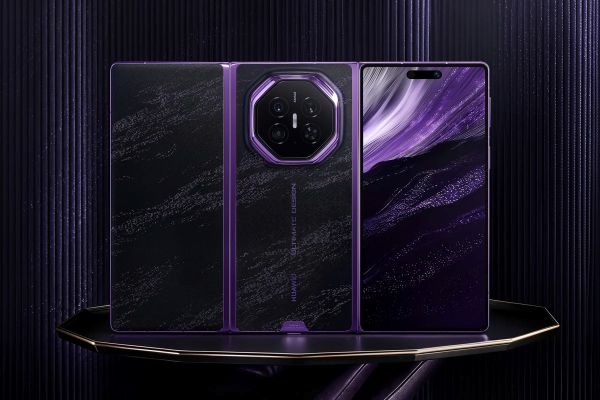
Huawei has launched a new tri-fold phone, the Mate XT 2, in China, equipped with the next-generation Kirin 9050 Pro mobile chip that applies its own “tau scaling law”. It features an in-folding structure similar to Samsung Electronics' tri-fold phone and a privacy display.
On Sept. 7, multiple foreign media outlets, including the South China Morning Post, reported that the Mate XT 2 starts at 19,999 yuan (about 4 million won) and is the first to carry Huawei's latest operating system, HarmonyOS 7. Sales begin on Sept. 10.
Richard Yu Chengdong (청둥) of Huawei, chairman of the Consumer Business Group, introduced the Kirin 9050 Pro as “the most powerful Kirin chip ever” at a launch event in Guangzhou, China. Huawei said the Mate XT 2's overall performance improved 42% from the previous model released last year. It is the first new Kirin chip unveiled at a flagship smartphone launch event in 6 years, since the Mate 40 series in 2020.
The Kirin 9050 Pro was designed based on the tau scaling law, which boosts performance by reducing semiconductor signal delay. The “logic folding” technology developed in the process stacks logic circuits inside the chip in layers and connects them vertically to shorten signal paths, allowing more transistors to be integrated into a smaller area. According to a paper Huawei released on Sept. 4, the Kirin 9050 Pro has 55% higher transistor density per square millimetre than its predecessor and reduced power consumption for some core tasks by as much as 66% under the same performance conditions. Power consumption fell 66% for the neural network processing unit (NPU), 58% for the graphics processing unit (GPU) and 41% for CPU performance cores. The paper was posted on ChinaXiv and has not yet undergone peer review.
Huawei has explained that using the tau scaling law could enable it to achieve transistor density equivalent to a cutting-edge 1.4-nanometre process by 2031, without relying on extreme ultraviolet (EUV) lithography equipment that is subject to U.S.-led export controls. He Tingbo (허팅보), chair of Huawei's Scientist Committee and president of its semiconductor business unit, disclosed the technology in May and said Huawei had used it over the past 6 years to design 381 chips and mass-produce them.
In terms of form factor, it adopts a structure similar to Samsung Electronics' Galaxy Z TriFold, folding the left and right sides of its 10.2-inch screen inward. Unlike the existing Mate XT series, which used an out-folding structure that left part of the screen exposed on the outside, the new design folds the screen inward to protect it from external impact. A privacy OLED display was also newly applied. It narrows the viewing angle so the screen appears almost black from the side while remaining visible from the front. It is available only on the top-end model with 16GB of RAM and 1TB of storage, with an additional cost of 1,000 yuan (about 200,000 won). It also supports an IP59 water and dust resistance rating and a triple rear camera. A global launch schedule was not disclosed.
HarmonyOS 7 is also being applied for the first time on the Mate XT 2. A beta version of the operating system, including an artificial intelligence (AI) coding agent, was released to developers in June, and distribution to existing Huawei smartphones also began on Sept. 7.
Competition in the foldable phone market is also intensifying. Xiaomi unveiled its premium foldable phone, the 18 Fold, on the same day, equipped with its self-designed Xring O3 processor. Apple is also expected to unveil its first foldable iPhone on Sept. 9. Market research firm Counterpoint Research forecast that global foldable phone shipments rose 18% last year and that the growth rate will accelerate to 24% this year and 37% in 2027.
Huawei's expanded semiconductor development is also weighing on profitability. In the first half of this year, research and development spending rose 25% from a year earlier to 121.4 billion yuan (about 24.3 trillion won), while net profit fell 36% to 23.8 billion yuan (about 4.8 trillion won). Revenue, however, rose 9.6% to 467.8 billion yuan (about 93.6 trillion won) on a rebound in smartphone shipments and increased demand for AI processors. According to IDC, Huawei ranked first in China's smartphone market in the second quarter with a 22.6% share, and shipments rose 19.4% from a year earlier.
 Seung-a Yoo
ysah@d-today.co.kr
Seung-a Yoo
ysah@d-today.co.kr