
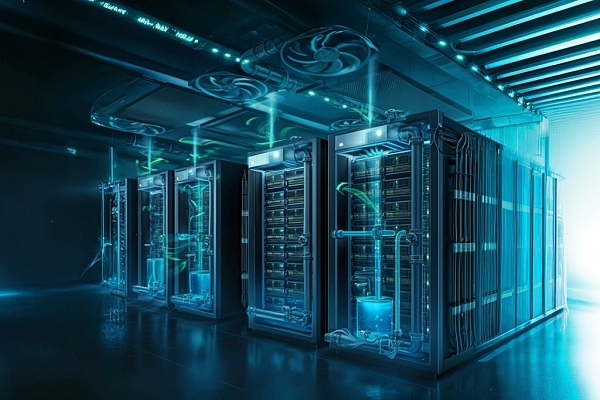
An analysis found that data centres in seven major U.S. states withdraw more freshwater annually than the combined urban water supply of all cities in California when water used not only for cooling but also in power generation is included. As AI data centres rapidly expand, the burden on water resources could rise along with demand for power and cooling.
On Sept. 8 (local time), IT outlet TechRadar reported that non-profit think tank Ceres released a report analysing water use by data centres and power generation in seven states: Virginia, Texas, California, Illinois, Georgia, Ohio and Arizona.
Ceres estimated that data centres in those areas use about 340 billion gallons, or about 10.4 million acre-feet, of freshwater a year. That exceeds California's annual urban water use of about 8 million acre-feet cited by Bloomberg Law.
The estimate includes water used inside data centres for cooling as well as water required during power generation to supply electricity to the centres. The analysis said rising power demand could become a water-resource issue as large-scale data centre construction continues with the spread of AI services.
Still, caution is needed in directly comparing the two figures. Ceres' figure is based on "withdrawals", meaning the total amount of water drawn from rivers, lakes and aquifers. Some of the withdrawn water can return to the original source after being used in power generation or industrial processes.
By contrast, California's 8 million acre-feet refers to urban water actually supplied and used in households, commerce, industry and landscaping. The two measures therefore differ in how water is taken out of the system.
Ceres also acknowledged the difference. It explained that withdrawals show the total volume of water facilities depend on for operations, and serve as an indicator of how much risk communities already under water stress from drought could face as data centres expand.
Comparisons with other research have also fuelled debate that Ceres' estimate looks quite large. Researchers at Arizona State University in 2024 estimated U.S. data centres' indirect water consumption using Lawrence Berkeley National Laboratory data. It included water use from power generation but came to about 650,000 acre-feet a year, far below the figure presented by Ceres.
That study has a limitation in that it used relatively old data. As data centres and AI infrastructure have expanded rapidly in recent years, it is hard for it to fully reflect current water use. Ultimately, the key issue is distinguishing how much water was withdrawn and how much of that was actually consumed.
Some also argue that considering the share of hydropower in the power generation process, it is difficult to say all withdrawn water is actually used up by data centres. As a result, Ceres' 10.4 million acre-feet can be seen less as the amount of water directly consumed by data centres than as an indicator of the scale of dependence on water resources linked to their operation.
Even so, concern over water shortages is growing. Ceres forecast that by 2030, water used for power generation could account for 72 percent of total water consumption by U.S. data centres when measured on a consumption basis.
That means even if cooling efficiency inside data centres improves, a sharp rise in power demand from the spread of AI services could increase the water burden from power generation instead.
Community pushback is also emerging. Ceres said that with major reservoirs on the Colorado River falling to record lows, opposition has continued over strains on water and power grids, and data centre projects worth about $130 billion were affected in the first quarter of 2026 alone. It said conflict over AI data centre construction is expanding from securing grid capacity to water resources.
Sharma Purvin (샤마 퍼빈), Ceres' water research lead and a co-author of the report, stressed that it is difficult for any single party to solve data centres' water issues alone. Data centre operators, power companies, local governments and communities need to consider water and electricity demand together, Purvin said.
As the AI industry expands, data centres are requiring more electricity. As a result, discussion is expected to grow over assessing the environmental burden of data centres by weighing not only water needed for server cooling but also indirect water use tied to power generation.
 Jinju Hong
hongjj@d-today.co.kr
Jinju Hong
hongjj@d-today.co.kr