
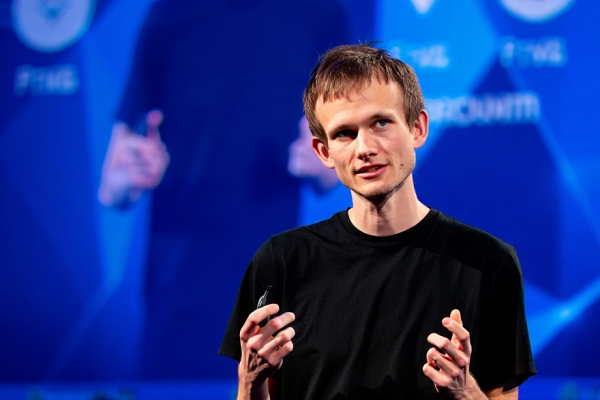
[DigitalToday Seung-a Yoo, intern reporter] Ethereum co-founder Vitalik Buterin (비탈릭 부테린) has voiced opposition to a forecast that artificial intelligence could cause the Bitcoin price to plunge more than 50 percent within the next 2 years.
On Sept. 7 (local time), overseas media including blockchain outlet CryptoSlate reported that Silicon Valley investor and AI risk analyst Liron Shapiro (리론 샤피로) said AI could shake assumptions investors have held about the security and resilience of the Bitcoin network. He put the probability of Bitcoin falling more than 50 percent within 2 years at 50 percent.
Buterin saw it differently. He said Bitcoin can handle security issues that can be addressed without social consensus, such as attacks targeting network infrastructure including clients and mining pools. He assessed the likelihood that AI could fundamentally break Bitcoin's hash function or proof-of-work (PoW) system as very low. Buterin said he would normally bet with Shapiro on the outcome, but his crypto holdings are effectively that bet already. He explained that about 90 percent of his net worth is invested in cryptocurrencies. He said the same logic would apply to Ethereum.
The difference in their views stems from the point that AI does not have to directly destroy Bitcoin's core cryptographic technology to shock the market. Shapiro argues that if AI finds large numbers of vulnerabilities that were previously hard to detect and shakes security assumptions investors took for granted, market trust could be damaged even if developers later fix the vulnerabilities. Buterin, by contrast, sees many AI-driven security issues as likely to remain at a level that can be fixed. As attackers use AI, defenders can also use the same advances to find vulnerabilities and respond, he said.
In the cryptocurrency industry, AI-driven attacks are already putting pressure on infrastructure. Bitcoin swap service Boltz said in August it suspended its swap service indefinitely after automated AI-assisted attack probing continued for months and vulnerabilities were exploited repeatedly. Boltz said user funds were not exposed to risk due to its non-custodial structure, but attackers repeated attacks faster than its small development team could find and fix vulnerabilities. That shows AI can pressure surrounding infrastructure in the Bitcoin ecosystem without directly attacking Bitcoin's proof-of-work or core cryptographic system. Wallets, bridges, exchanges, smart contracts and blockchain operating software have more entry points that attackers can target than Bitcoin's core consensus mechanism.
Deddy David (데디 데이비드), chief executive of blockchain security firm Cyvers, has forecast that financial damage from AI-based crypto attacks could reach hundreds of millions of dollars to several billion dollars in the future. He said if AI can find vulnerabilities in core internet infrastructure at scale, the crypto market could be one of the first areas to be affected.
Efforts to strengthen defensive technology against AI-driven attacks are also continuing. Anthropic has restricted general release of Claude Mythos Preview, which has the ability to autonomously find and exploit software vulnerabilities, and is using it for defensive purposes through Project Glasswing. Amazon Web Services, Google, Microsoft and JPMorgan Chase are participating in Project Glasswing. They are using Claude Mythos Preview to identify and fix vulnerabilities in major software, and Anthropic has decided to provide up to $100 million in usage credits for the project.
In August, more than 100 companies and institutions including OpenAI, Anthropic and Microsoft also signed an open letter urging joint action to respond to AI-based cyberattacks. They said as AI technology advances, the scale and sophistication of cyberattacks could grow rapidly, and called for strengthening defenses for critical infrastructure including hospitals and water supply facilities.
Ultimately, the core of the debate is not only whether AI can directly break Bitcoin's cryptographic system. A more direct issue is whether attackers can gain an edge before defensive technology, security auditing systems and network infrastructure catch up. Buterin sees most AI-based security problems as likely to remain manageable and fixable, while Shapiro warns that investor trust in security could collapse first in the process.
 Seung-a Yoo
ysah@d-today.co.kr
Seung-a Yoo
ysah@d-today.co.kr