
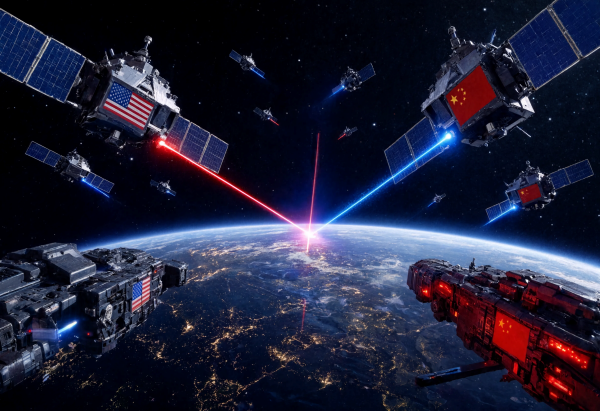
U.S. security officials are issuing repeated warnings that if the United States and China clash militarily over Taiwan, actual fighting could begin first in space, not on the ground. As China rapidly expands satellite capabilities and anti-satellite weapons development, some analysts say the U.S. military’s reliance on space could become a weakness.
On Sept. 2, blockchain media outlet Cryptopolitan reported that U.S. security officials are watching the possibility that space could become a main battleground in a Taiwan contingency, saying China has already been developing and testing orbital weapons systems.
The key issue is the U.S. military’s high dependence on space. In an analysis released in September last year, the Council on Foreign Relations raised the possibility that if China attacks Taiwan, it could use ground-based lasers to neutralise U.S. reconnaissance satellites monitoring the Taiwan Strait. It said that if China also attacks satellites that support targeting and communications for U.S. ships and aircraft, the United States and its allies could effectively be forced to fight “blind.”
The U.S. Space Force also views competition over space as a core security task. Its engagement doctrine, released in April last year, focuses on maintaining “space superiority” and preventing an adversary from gaining the initiative in space.
What the United States is particularly wary of is China’s rapid expansion of its space power. According to U.S. Space Force space threat data, China conducted 37 orbital launches in June alone and is currently operating more than 1,506 payloads in orbit. More than 510 of them are classified as satellites capable of detecting U.S. aircraft carriers and expeditionary forces.
China has set this year’s launch target at 140, up 52 percent from its previous goal. Anti-satellite weapons are also an area China has developed for a long time. In 2007, the Chinese People’s Liberation Army destroyed an ageing weather satellite using a ground-launched missile. The U.S. Defense Intelligence Agency judges that China is seeking to secure the ability to launch anti-satellite weapons that can reach geostationary orbit about 36,000 km away.
Within the U.S. military, concern is growing over the pace of China’s rise. Lt. Gen. Gregory Gagnon (그레고리 개뇽), who oversees Space Force combat operations, assessed in Canberra, Australia, this year that China has the world’s largest space force and that it is three times larger than U.S. space capabilities. He said China’s satellite count, at about 70 in 2013 early in Xi Jinping’s rule, has now risen to around 1,400. Gagnon said China’s expansion in space is not moving slowly, but progressing like a world-class sprinter.
The United States and its allies are also stepping up their response. Gagnon said the United States and Australia cannot remain on the defensive and need to be prepared to neutralise Chinese space systems that track allied ships and troops. The Department of the Air Force has requested $338.8 billion for the next fiscal year, allocating $71.1 billion of that to the Space Force. The Space Force budget is up 124 percent from the previous year, and $21.6 billion has been earmarked for space control programmes.
Reusable rocket technology is also emerging as an important element of space warfare. China recovered the first stage of a Long March-10B rocket using a net-capture method on July 10, and on Aug. 19 succeeded in a controlled landing of the 66.1-metre private rocket Zhuque-3. Advances in reusable launch technology could allow rapid replacement of satellites destroyed in war or the quick buildout of large satellite constellations.
China is already pushing to build a large satellite constellation to counter Western satellite networks and has already launched hundreds of satellites for that purpose. Russia is also pushing to build the low-Earth-orbit constellation Rasvet, but military specialist outlets are raising the possibility that Russia could fall behind in the U.S.-China space race.
In the private investment industry, a view of space as a new battleground is also spreading. Andreessen Horowitz (a16z) pointed out in its June report, “How to Win a Space War,” that Russia has been jamming GPS receivers across Eastern Europe and that China has also publicly examined the possibility of attacking Starlink.
Russia’s cyberattack early in its 2022 invasion of Ukraine, which paralysed Viasat’s Ka-Sat network, is also cited as a representative case of space and communications warfare. Ukraine at the time had to rely on other commercial services such as Starlink to maintain communications.
U.S. security officials are watching the possibility that if the United States and China enter an actual clash over Taiwan, the first stage of the war could be space warfare over satellite communications, reconnaissance and positioning information.
That is because losing satellites could weaken the ability to track an enemy’s movements and command forces. It does not mean, however, that such an armed conflict is imminent. The view is gaining weight that space is emerging as a key domain that will determine victory or defeat in future military conflicts.
 Jinju Hong
hongjj@d-today.co.kr
Jinju Hong
hongjj@d-today.co.kr