
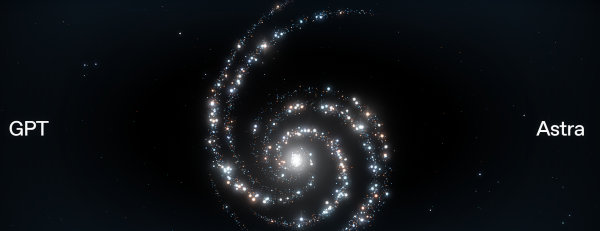
[Digital Today Seungah Yoo, intern reporter] OpenAI unveiled a new artificial intelligence (AI) model, "GPT-6 Astra," and said the era of artificial general intelligence (AGI), long seen as a key goal in the AI industry, has begun.
On Sept. 3 (local time), foreign media including Business Insider reported that OpenAI unveiled GPT-6 Astra and began distributing it to customers. OpenAI described Astra as a major research outcome and said it made significant advances in professional task performance.
OpenAI has defined AGI as a highly autonomous system that surpasses humans at most economically valuable work. The company said Astra is a turning point that greatly expands the range of tasks that can be delegated to AI. Greg Brockman (그렉 브록먼), president of OpenAI, said at the end of a launch call, "Welcome to the AGI era."
Brockman has viewed AGI as a process that forms gradually rather than a specific moment reached all at once. He said that when people look back, they will think AGI was "made around now, perhaps with this model," adding, "Personally, I think we are already at that point." He added that this does not mean a technical or academic consensus on AGI has been reached, but reflects OpenAI's judgment.
The model comes about 1 year after OpenAI released the GPT-5 line and about 2 months after it unveiled GPT-5.6, a recent upgraded model. OpenAI introduced Astra as the most intelligent and aligned model in the world and said it will bring a step change in how professional work is performed.
On practical use, OpenAI said Astra significantly improves ChatGPT's computer-use capability. The computer-use feature carries out tasks directly on a user's desktop or internet browser. Astra can perform a range of tasks including filling out forms, formatting documents, managing schedules and operating software. OpenAI said Astra can quickly take over anything that can be done on a computer.
Computer-task automation has long been pursued by Big Tech companies including OpenAI, but there have been multiple difficulties in implementation. Desktop environments and work methods vary by user, and existing computer-use AI tools have had limits in speed and stability.
OpenAI said it strengthened safeguards ahead of release after judging Astra's cybersecurity capability had reached a "critical" level by the company's standards. It assessed that if Astra is given appropriate tools and access privileges, it could find unknown security vulnerabilities and exploit them without a person directing each step. It therefore strengthened protections against cyber misuse and unauthorised actions, and delayed some development and launch schedules.
OpenAI said Astra has stronger cybersecurity capabilities than earlier models, but Astra itself was not involved in a previous incident related to Hugging Face. The company said it reflected lessons from that incident in Astra's safety measures.
Debate over AGI continues. Demis Hassabis (데미스 허사비스), chief executive of Google DeepMind, suggested in May that AGI could be reached between 2029 and 2031, especially around 2030. Sam Altman (샘 알트먼), OpenAI's CEO, recently called AGI "a very poorly defined term" and closer to a marketing term, but also said the current model is "at least very close" to AGI.
Against that backdrop, OpenAI appears to be seeking to shift the AGI discussion through Astra from an abstract concept to a question of real-world task performance. Key points to watch are how quickly and reliably Astra can operate computers in actual customer environments, and whether safeguards for its stronger cybersecurity capability will continue to work effectively after deployment.
This is GPT-6 Astra. Anything you can do on a computer, Astra can do for you. Fast. pic.twitter.com/gDd0IsewJw
 Seungah Yoo
ysah@d-today.co.kr
Seungah Yoo
ysah@d-today.co.kr