
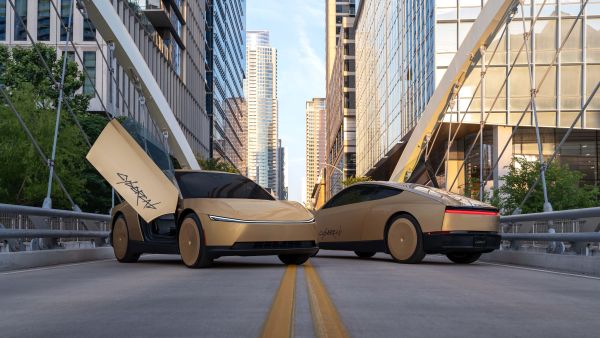
Tesla has unveiled its robotaxi "Cybercab" without a steering wheel or pedals, and anticipation is growing in Austin, Texas.
On Sept. 4 (local time), X, formerly Twitter, saw a range of reactions to a gold Cybercab spotted on the street. The Cybercab is a two-seat vehicle that drives based on cameras and artificial intelligence (AI). Tesla also released an official rider guide for the North American market that day and shared detailed specifications and how passengers can use the vehicle.
According to the rider guide, the rear trunk cargo space is 20.2 cubic feet (572 liters) and can carry up to 220 pounds (about 100 kg). Tesla gave examples of luggage it can carry: two standard checked bags and two carry-on bags; two carry-on bags and two golf bags; one large folding stroller; and one small folding wheelchair. The Cybercab has no front trunk (frunk), and the hood does not open.
Its exterior dimensions are a step-in height of 16.5 inches (about 419 mm), width of 69 inches (about 1,754 mm), height of 55.4 inches (about 1,408 mm), and ground clearance of 5.7 inches (about 144 mm). Interior measurements were listed as headroom of 38.3 inches (about 972 mm), legroom of 43.4 inches (about 1,103 mm), shoulder room of 51.8 inches (about 1,317 mm), and hip room of 50.1 inches (about 1,273 mm).
The cabin has two seats and no steering wheel, accelerator pedal or brake pedal. There is also no glove compartment. Each seatback can be adjusted, but the seats move forward and backward together, and the headrests are integrated and cannot be adjusted. Seat adjustments can be made on the touch screen and in the robotaxi app. Passengers can turn off airflow from their own vents and use USB-C charging ports. The climate system itself cannot be fully turned off. The windows open and close with a switch below the touch screen, but they do not currently open fully and there are no window buttons on the door panels.
The future has arrived in Austin pic.twitter.com/RTCb0O5sez
Boarding conditions are stricter than for regular vehicles. Tesla specified that minors under 13 cannot ride the Cybercab. If a booster seat is required, it must be installed according to the manufacturer's instructions, but the Cybercab has no LATCH·ISOFIX anchors and can only be secured using the vehicle seat belt. The ride starts only when all occupants have their seat belts fastened, and they must remain fastened while driving. If improper use is detected, the vehicle can pull over to the shoulder or cancel the trip. Tesla recommended keeping the seatback under 35 degrees from vertical and keeping both feet on the floor. The seat belt includes a built-in motor that automatically tightens slack at the start of a trip.
An interior camera is installed next to the dome light. During trips it is used for customer support and occupancy detection, and it is also used when an operator's support is needed in an emergency. The support agent can access the interior camera while on a call with a rider. After a trip, it is used to check interior cleanliness and lost items. When the camera is active, a green indicator appears on the touch-screen menu bar, and when the microphone is used, an orange indicator appears. Passengers can choose whether to share camera analysis data, and even if they agree, the data is not linked to their account.
During passenger pickup, the rear light bar turns red and the front light bar changes color. The robotaxi app tells the passenger the assigned front light bar color, and the passenger must match the license plate shown in the app with the actual vehicle. When the vehicle stops, hazard lights flash. The Cybercab automatically opens the door when it detects the requester's phone. If an obstacle is detected, the door will not open automatically, and the passenger must press and hold the door button or tap "Hold to Open" on the touch screen. The door opens outward and upward, and mechanical release devices for power-loss situations are provided on both doors.
On the in-car touch screen, passengers can check trip progress and estimated arrival time, and adjust cabin temperature, seats and volume. When a trip begins, an app launcher appears with Music, Arcade and Media apps, and account information entered to use media services is deleted from the vehicle after the trip ends.
Emergency response tools are also provided. If there is no immediate danger, passengers can request a stop using the "Pull Over" function on the touch screen, and in an emergency they can use the STOP button between the dome lights. The vehicle is equipped with a two-way communication device that allows passengers to speak with robotaxi support staff from inside the cabin.
Tesla's messaging has also become more aggressive. Ashok Elluswamy (아쇼크 엘루스와미), Tesla's head of AI, recently posted on X that streets will no longer be the same as before. Elon Musk (일론 머스크), Tesla's chief executive, also responded positively to a post saying Tesla would soon cover Austin.
The Cybercab launch is also directly tied to Tesla's business direction. If Tesla successfully builds a robotaxi network centered on the Cybercab, it could be an important turning point showing it is shifting from an automaker to an AI·robotics company.
Musk has promised for more than 10 years fully autonomous driving for Tesla vehicles and a robotaxi network based on it.
Tesla's flagship software, supervised Full Self-Driving (FSD), has become more advanced but is still a driver-assistance system. Responsibility and legal liability also remain with the driver. The Cybercab was presented as a vehicle to implement a robotaxi that goes beyond these limits and does not require driver intervention.
Cybercabs are taking over Austin pic.twitter.com/z2XFMciCeR
 Seung-a Yoo
ysah@d-today.co.kr
Seung-a Yoo
ysah@d-today.co.kr