
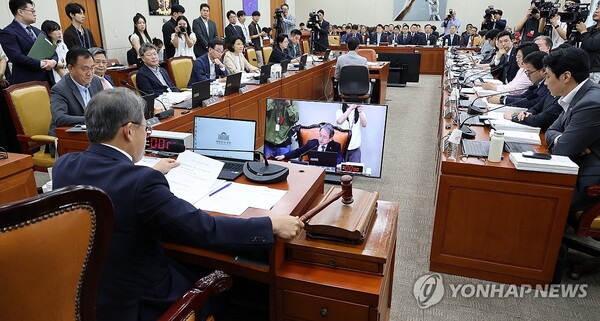
[DigitalToday reporter Seulgi Son] With the government declaring this year the first year of its push to become an "AI G3" and injecting large-scale public funds, the 2026 parliamentary audit is expected to see market performance of a homegrown AI foundation model, a plan to operate 260,000 GPUs and AI chatbot safety emerge as key issues.
A recent National Assembly Research Service report, "2026 Parliamentary Audit Issue Analysis", listed AI issues under the jurisdiction of the Science, ICT, Broadcasting and Communications Committee as wider market adoption of the homegrown foundation model, securing power for GPUs, an outflow of AI talent overseas, and AI literacy and protection for children and teenagers using chatbots.
The analysis does not bind questions in the audit, but is used as reference material for lawmakers' offices preparing questions and document requests. The report includes sample questions by issue and specific materials to demand from the government, raising the possibility of continued questioning over the effectiveness of related policies.
FACTBOX- Higher-performance homegrown model - market results and substitution for foreign models
The first issue expected to come under scrutiny is the homegrown foundation model. The government invested in GPUs, training data and costs to attract talent to boost the performance of domestic AI models, but verification is expected over whether that has translated into actual market entry and substitution for foreign AI.
The government selected five teams in August last year - LG AI Research, SK Telecom, Upstage, Naver Cloud and NC AI - and introduced a competitive format that eliminates lower-ranked teams through phased evaluations every six months. After a first evaluation in January, the second evaluation in August reflected the real user experience of 200 members of a public evaluation group, alongside technical and expert assessments.
The National Assembly Research Service assessed that participating teams improved model performance, technological independence and inference efficiency, but services based on the models have so far remained centred on the public sector and companies participating in consortia. It said evaluation criteria placed weight on technological independence and excellence, leading companies to focus on securing evaluation scores rather than launching commercial services.
The research service analysed that "the original purpose of the homegrown foundation model project is to replace foreign AI models, but government support focused on technology development and support for market entry was insufficient". It added that the evaluation structure effectively provided an incentive for elite teams to focus on technical scores rather than entering the market.
The influence of foreign AI in South Korea grew instead. According to the government's "2025 Internet Usage Survey", among users of generative AI services, the share using ChatGPT was 41.8 percent and Gemini was 9.8 percent, while the domestic service CLOVA X stood at 2.0 percent. A Wiseapp-Retail survey also showed the average monthly number of ChatGPT users in the first half of this year was 23.24 million, up 9.86 million from the same period a year earlier.
The audit is expected to focus on each team’s record of support for GPUs, data and talent recruitment, the results of the first and second evaluations, and the status of services launched based on the homegrown model. How to use resources投入 into teams that were eliminated and the models they developed will also be an issue. Demands could also emerge to reflect market results in evaluations, including usage rates, revenue, and adoption in the public and private sectors, not just technical performance.
An AI industry official said, "Because it is a competitive format that requires results in a short period, it is regrettable that an AI ecosystem that should grow together was not sufficiently formed during the model advancement process." The official added, "To create a market, it would be good to introduce vouchers that can be used only in the AI area and, based on that, induce companies to reinvest."
FACTBOX- 260,000 GPUs secured, but plans for power and water under scrutiny
Plans to actually operate 260,000 high-performance GPUs that the government is seeking to secure are also a major issue. The research service estimated that operating 260,000 GPUs would require up to 1 gigawatt of constant power. It said that even if there is room in nationwide power supply, whether the GPUs can be brought online on time could vary depending on grid conditions at each data centre where the GPUs are placed.
The research service diagnosed that "whether GPUs can be operated depends not on the national total, but on the power supply conditions in the region where each individual data centre is located". It said that "a direction of 'dependence on a distributed power mix' alone cannot be considered a plan", and analysed that detailed plans are needed, including power volumes to be secured by region and supply timing.
In the audit, key questions are expected to include annual and regional GPU allocation plans, estimates of power and water demand, and spare capacity in regional power grids. Whether the plan to introduce 260,000 GPUs was verified based on actual power and water use of GPUs deployed at the Gwangju National AI Data Center and in the homegrown foundation model project is also set to be checked.
A cloud industry official said, "If the same total electricity and water volume regulations are applied nationwide, it can constrain not only data centres but also growth of the AI and cloud industries." The official added, "Regulations should be differentiated to reflect regional power grid and water conditions, and for efficiency improvements and renewable energy investment, streamlined licensing and incentives should be pursued in parallel."
FACTBOX- Protecting teenage AI chatbot users - issue extends beyond content to 'design responsibility'
User safety in AI use is also likely to be covered in depth. Calls have been raised for safeguards from the service design stage to prevent children and teenagers from becoming excessively immersed in, or emotionally dependent on, AI chatbots.
AI chatbots can increase usage time and emotional dependence through reward-like feedback such as praise and empathy, encouraging deeper relationships, repetitive questions and push notifications. But the government has been criticised for failing to 마련 specific standards to compare and assess major operators on age verification, blocking harmful conversations, managing usage time, and responses to high-risk situations such as self-harm and sexual conversations.
The research service diagnosed that "the risks of AI chatbots are difficult to prevent sufficiently only by deleting or blocking harmful answers after they are generated". It said risks can arise not only from the content of individual answers but also from the service structure and usage patterns, and that over-immersion and emotional dependence should be reduced from the design stage.
In a survey by the ChildFund Korea, 94.4 percent of children and teenagers said they had experience using AI chatbots, and among them 75.3 percent said they had acted on chatbot answers or seriously considered doing so.
The audit is expected to examine protection measures for minors by major domestic AI chatbot operators, functions to prevent over-immersion, and the status of user reports and complaint handling. Another issue is an all-government response system to coordinate protection duties dispersed across the Ministry of Science and ICT, the Ministry of Education, the Ministry of Health and Welfare, the Ministry of Gender Equality and Family, the Personal Information Protection Commission and the Broadcasting Media Communications Commission.
In addition, measures to address AI talent leaving overseas and education policy that is skewed toward how to use generative AI are also cited as audit issues. According to the research service, South Korea's net inflow rate of AI talent was minus 0.36 people per 10,000 population, ranking 35th among 38 OECD countries.
As the government is pursuing 741 AI projects across 41 ministries this year and budgeted 9.9 trillion won, questioning in the audit is expected to stand out for focusing on industry and market results rather than the size of investment. Whether foundational policies on power, talent and safety are keeping pace with the speed of industry growth will also be a key subject of verification.
 Seulgi Son
sageson@d-today.co.kr
Seulgi Son
sageson@d-today.co.kr