
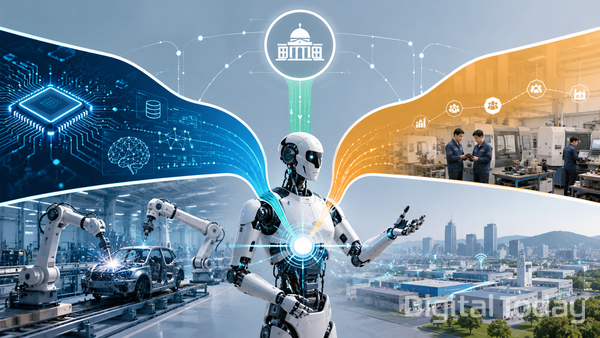
The government will strengthen an inter-ministerial cooperation framework, from technology development to demonstration and commercialisation, to expand the adoption of physical AI by small and medium-sized manufacturers.
The Ministry of Science and ICT and the Ministry of SMEs and Startups on Sunday visited the Korea Advanced Institute of Science and Technology (KAIST) Physical AI Demonstration Lab and held a meeting attended by technology suppliers and manufacturing companies with on-site demand.
The event was arranged to build a cooperation framework that links the science ministry’s physical AI technology development and demonstration capabilities with the SMEs ministry’s support policies for small manufacturers. The two ministries plan to connect technology suppliers and manufacturing users through the Physical AI Alliance and support technology development and demonstrations that reflect on-site demand.
A key cooperation task will push physical AI adoption and broader use by small manufacturers by linking the "AI plant manager for everyone" initiative with "Smart Manufacturing Innovation".
The science ministry will support the staged adoption of technology by small manufacturers using physical AI full-stack technology secured through demonstration projects for unmanned factory control and operations in North Jeolla Province and ultra-precision manufacturing intelligence in South Gyeongsang Province. This year, it will start with consulting on the introduction of autonomous mobile robots (AMR) and automated guided vehicles (AGV) in individual logistics sections. From 2027, it will support the introduction of heterogeneous equipment across entire logistics sections and provide precision manufacturing data. From 2028, it will expand support by offering consulting and operating systems to integrate management across logistics and production processes.
The SMEs ministry will support the creation of manufacturing environments and demonstrations so that physical AI technology can be applied at small manufacturers through smart factories. It will prepare a tailored support programme so that small businesses can use the science ministry’s "AI plant manager for everyone" service while also pursuing smart factory construction. Strong results will be expanded through the "ManufacturingAI 24" platform to be built in the future. ManufacturingAI 24 is an integrated support platform for manufacturing AI that links manufacturing data, solutions, supplier companies and government programmes.
The two ministries will also plan joint research and development for physical AI, focusing on new growth areas including new security, pharmaceuticals and bio, climate tech and K-consumer goods. The science ministry will support the development of core original and foundational physical AI technologies, while the SMEs ministry will handle technology application and demonstrations reflecting on-site manufacturing demand and commercialisation potential.
A task force specialised for small manufacturers will also be formed within the Physical AI Alliance. The task force will identify demand at small manufacturing sites and support on-site application by linking with technology suppliers.
Ryu Je-myeong (류제명), second vice minister at the Ministry of Science and ICT, said that to generate tangible results at industrial sites from physical AI, one of three mega projects, it is important to build a virtuous cycle system that connects on-site demand to demonstrations and broader adoption. He said the ministry will actively support the application of domestic technology at manufacturing sites.
Noh Yong-seok (노용석), first vice minister at the Ministry of SMEs and Startups, said that small manufacturers need successful cases to rapidly adopt strong physical AI technology. He said the ministry will also actively push to establish a data-based feedback system so that small businesses can use strong results.
 Jin-ho Lee
jhlee26@d-today.co.kr
Jin-ho Lee
jhlee26@d-today.co.kr