
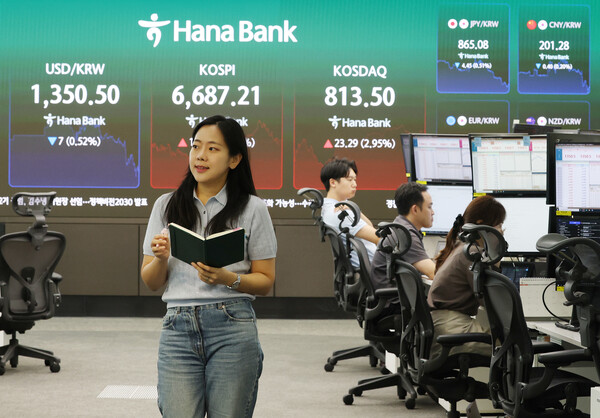
South Korea's stock market is expected to look for direction this week as it checks U.S. inflation indicators. Strong semiconductor results and solid exports are supporting the downside for the index, but U.S. long-term yields and instability in the Middle East are limiting upside momentum.
The KOSPI closed on Sept. 4 up 107.73 points, or 1.64 percent, at 6,687.21, rising for a second straight session. The KOSDAQ also ended up 23.29 points at 813.50. Investors' sentiment improved on cheaper valuations after a recent sharp fall and strong exports.
But U.S. stocks retreated again on rate worries. On Sept. 4, the Dow Jones Industrial Average fell 0.51 percent to 53,414.25, the S&P 500 dropped 0.38 percent to 7,718.60 and the Nasdaq slid 0.29 percent to 26,506.99.
U.S. nonfarm payrolls for August rose by 162,000, far exceeding market expectations and adding to rate worries. The unemployment rate held at 4.1 percent. After the jobs report, the 10-year U.S. Treasury yield rose as high as 4.78 percent, and the market-implied probability of a September policy rate hike climbed to around 60 percent.
The market's focus is expected to shift from jobs to inflation this week. The U.S. Bureau of Labor Statistics will release the August producer price index on Sept. 10 and the consumer price index on Sept. 11. They are effectively the last major inflation indicators to be checked ahead of the Federal Open Market Committee meeting on Sept. 15 to 16.
If inflation stays within expectations or eases, it could reduce concerns about additional tightening that have risen on strong employment. If rising international oil prices feed into inflation and the CPI and PPI come in above forecasts, U.S. Treasury yields and the dollar could rise again and weigh on South Korean stocks.
International oil prices have stayed high as military clashes between the United States and Iran have intensified again. On Sept. 4, Brent crude and West Texas Intermediate rose to the $92-a-barrel range and the $91-a-barrel range, respectively. If oil prices stay elevated, the pace of disinflation could slow and affect the Federal Reserve's rate decisions.
In South Korea, solid corporate earnings are a support. Korea's August exports rose 68.7 percent from a year earlier to $98.25 billion. Semiconductor exports jumped 209 percent to $46.65 billion, hitting a record high.
Exports related to information technology, as well as earnings improvements in non-semiconductor sectors, are also continuing. That has led to an assessment that the earnings outlook for South Korean companies has not been significantly shaken.
But it may not be easy for semiconductors alone to lift the index quickly. Samsung Electronics and SK Hynix have recently rebounded, but gains have not spread broadly across the overall market.
Buybacks by large semiconductor stocks are absorbing foreign selling and supporting the downside for the index. If U.S. rates stay high, however, a sustained improvement in foreign flows may be limited.
The industry therefore sees the market as likely to continue for the time being, with buybacks setting a floor and rates setting a ceiling. Shareholder returns by large semiconductor stocks create buying demand when share prices fall, but if long-term yields rise again, valuation pressure on growth stocks can increase and cap the upside for the index.
Rates also matter for the KOSDAQ. Valuation pressure has eased after a recent price correction, but the market has a higher share of growth companies that are more sensitive to rates than large KOSPI stocks. If rates stabilise and flows concentrated in large semiconductor stocks become more dispersed, there is room for rotation into the KOSDAQ to broaden.
Ultimately, the key this week is how the Sept. 10 PPI and Sept. 11 CPI could change the rate path for the September FOMC. Exports and earnings for domestic companies are solid, but if U.S. Treasury yields surge again, the index could continue to fluctuate in a range for the time being.
If inflation proves more stable than expected, the KOSPI could also attempt to retest the 7,000 level as rate worries ease.
Lee Kyung-min (이경민), a researcher at Daishin Securities, analysed that "external uncertainty has increased, but earnings, economic and policy momentum remain valid, so we expect valuation normalisation and an index rebound based on improving earnings," he said.
Noh Dong-gil (노동길), a researcher at Shinhan Investment, described it as a section where "buybacks set the floor, and oil prices and rates set the ceiling." He said oil prices and whether rates stabilise will determine the strength of any rebound.
 Sangyeop Oh
yub@d-today.co.kr
Sangyeop Oh
yub@d-today.co.kr