
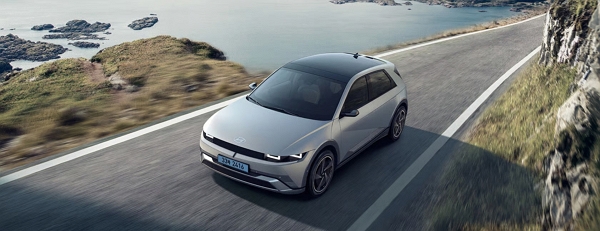
[DigitalToday intern reporter Seungah Yoo] Hyundai Motor's Ioniq 5 posted strong battery health results in a large survey based on 500,000 used electric vehicle (EV) battery diagnostic records. It showed the highest remaining battery performance among surveyed vehicles at 50,000 km and 100,000 km, beating Tesla's Model Y and Model 3.
On Sept. 2 (local time), IT outlet TechRadar reported that Austrian battery diagnostics firm Aviloo analysed used-car battery condition for 20 popular EV models from 2022 to 2026. The Ioniq 5 showed higher battery health than key comparators, the Tesla Model Y and Model 3.
The survey was conducted based on 500,000 independently carried out EV battery health checks. Aviloo reflected the results in its "Aviloo Certified EV Battery Report" and said it was the largest used-EV battery health study based on a database holding more than 1 million data points worldwide.
The key metric was remaining battery performance. The Ioniq 5 posted a median battery health of 97.2 percent at 50,000 km and 95 percent at 100,000 km. It maintained 92.8 percent after 150,000 km. At 150,000 km, the Tesla Model Y was at 90.3 percent and the Model 3 at 88.94 percent.
At 150,000 km, however, the Mercedes EQA narrowly topped the Ioniq 5, at 93.97 percent versus 93.79 percent. The Ioniq 5 ranked first at 50,000 km and 100,000 km, and showed battery health at virtually the same level as the EQA at 150,000 km.
Smaller compact EVs with relatively lower battery capacity recorded weaker results. The Nissan Leaf ZE1, fitted with a 40 kilowatt-hour (kWh) battery, scored 86.67 percent at 150,000 km, while the Renault Zoe was at 87.33 percent and the first-generation Mini Cooper SE at 87.11 percent.
A notable point in the survey was not only model rankings but also dispersion between individual vehicles. The Tesla Model Y ranged from 82.9 percent to 94.9 percent in battery health at 150,000 km. The BMW i4 ranged from 87.5 percent to 96.9 percent under the same condition. That means even used EVs with the same mileage can differ significantly in real-world range and performance.
Aviloo Chief Executive Marcus Berger (마르쿠스 베르거) said average values alone make it difficult to adequately assess battery condition. "The truth this data shows is that averages hide a lot," he said. "EV batteries last longer than the common belief that they wear out quickly, but more importantly, there are big differences between models and big differences between individual vehicles within the same model," he said.
Aviloo stressed that independent battery diagnostics are important rather than relying only on battery health figures shown on a vehicle's instrument system. The company explained that climate, charging habits, battery chemistry and usage patterns such as keeping a high state of charge for extended periods can affect battery degradation. "What matters is that battery health varies greatly between models, and varies even more greatly between individual vehicles of the same model," Berger said.
Overall, the results somewhat eased concerns about EV batteries. Most vehicles in the survey maintained at least about 90 percent of initial battery capacity even after driving 150,000 km. That shows a gap between the perception that EV batteries will quickly reach the end of their life and actual usage data.
That could change criteria used to judge the used-EV market. Rather than simply checking model or mileage, vehicle-specific battery diagnostic results could become a key indicator for assessing transaction value and performance. The survey showed that EV battery durability is broadly stable and that it is important to check battery condition for individual vehicles even within the same model.
 Seungah Yoo
ysah@d-today.co.kr
Seungah Yoo
ysah@d-today.co.kr