
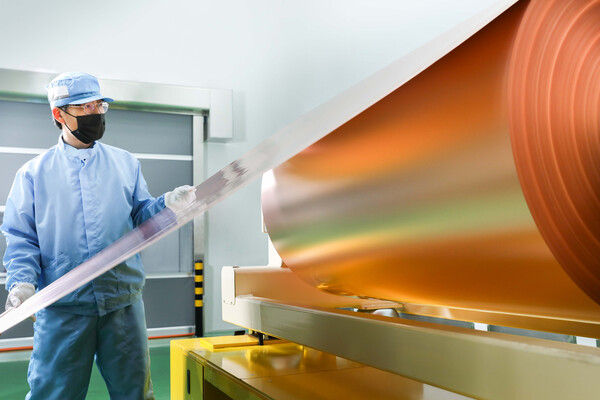
SK Nexilis has secured copper foil materials technology for next-generation batteries. The company said on Monday it developed a "high-adhesion carbon-coated copper foil" that coats the surface of copper foil with special carbon to boost adhesion with anode materials. SK Nexilis is a company that SKC invested in for its secondary battery copper foil business. The technology focuses on reducing delamination in which active materials in battery electrodes peel away from copper foil, the company said.
The battery industry is increasing the silicon content used in anode materials to raise energy density. Silicon anodes expand in volume through charging and discharging. As the silicon proportion rises, adhesion between anode materials and copper foil becomes more important. SK Nexilis said it focused its development on strengthening that adhesion.
The newly developed copper foil can also be used in dry electrode processes, in which electrode materials are applied in powder form without solvents. The dry process is discussed as a next-generation manufacturing method because it can reduce battery manufacturing costs and energy use. Securing adhesion between electrode materials and copper foil is also an essential condition in this process. The company said it expects strong applicability of the developed technology.
When the carbon coating layer firmly holds the anode material and copper foil together, the electrode structure becomes stable. This can contribute to improving battery life and safety, the company said. It can respond at the same time to high-silicon anode materials and dry electrode processes.
SK Nexilis will begin building a pilot production system for the high-adhesion carbon-coated copper foil. It is currently verifying process stability. The company plans to pursue commercialization in the second half of 2027 after securing mass-production technology.
An SK Nexilis official said, "This development of high-adhesion carbon-coated copper foil is an achievement aimed at responding to technological changes in the next-generation battery market, such as the expansion of high-silicon anode materials and the introduction of dry electrode processes." The official added, "While proceeding without disruption in optimization work for commercialization, we will strengthen competitiveness in the next-generation battery materials market through continuous technology development."
 Seok Dae-geon
d2dg@d-today.co.kr