
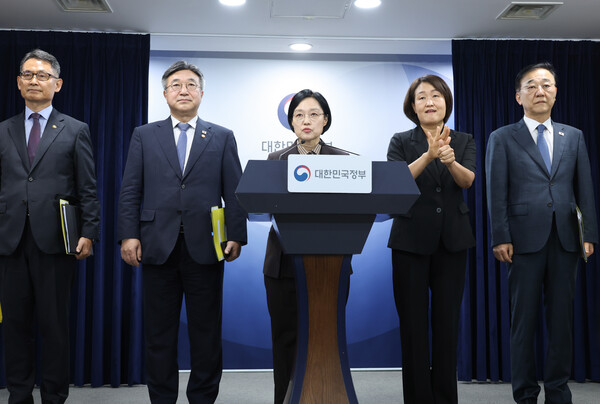
The government will consolidate facility and customer management subsidiaries that have been scattered across policy finance institutions into function-based groups. Whether financial public institutions in the Seoul metropolitan area will be relocated to other regions remains a variable.
Under the government’s plan to promote public institution function reforms announced on Sept. 3, the financial sector will pursue a plan to integrate facility and customer management subsidiaries by function across policy finance institutions.
In facility management, five companies - KAMCO FMC, Yeoul FMC, San-eun Biz, Su-eun Plus and Shinbo Operation Management - will be merged into a tentatively named Policy Finance FMC. In customer management, KAMCO CS and HF Partners will be integrated into a tentatively named Policy Finance CS.
The government plans to bundle facility and customer management subsidiaries that have been operated separately by each financial public institution, shifting to a function-centred management system rather than an institution-based one.
Among institutions under the Financial Services Commission, KAMCO Ship Management, under Korea Asset Management Corp (KAMCO), will be integrated into KAMCO. KAMCO FMC, Yeoul FMC, Shinbo Operation Management and San-eun Biz will be reorganised under the Policy Finance FMC framework, and Su-eun Plus, under the Ministry of Finance and Economy, will also be transferred to Policy Finance FMC.
The Korea Development Bank was also put on the list for subsidiary restructuring. The government’s detailed reorganisation plan includes integrating KDB Investment, which has a staff of 6, into the bank.
Policy finance subsidiaries consolidated; common support functions to be grouped
A key feature of the financial sector overhaul is the integration of support organisations that have been separately operated by each institution, rather than the core financial functions of policy finance institutions.
The government will apply an approach under which a parent company absorbs a subsidiary if the subsidiary performs work that is similar or related to the parent, while subsidiaries that do similar work are merged horizontally. In finance, functions such as facility and customer management that have been duplicated across institutions were selected as representative integration targets.
The government plans to reduce or reorganise a total of 109 entities across all public institutions, including 15 strategic structural reforms, 11 consolidations of similar and overlapping functions, and 83 integrations of subsidiaries and small institutions. Among these, the restructuring of subsidiaries and small institutions accounts for the largest share.
It plans to carry over employment for staff at institutions that are merged or abolished. The government also said it will ensure pay and other treatment do not worsen before and after consolidation, and will prepare support measures such as welfare benefits and management evaluation incentives.
Whether capital-area financial public institutions will be relocated remains variable
Another variable surrounding financial public institutions is the second phase of the relocation of public institutions outside the capital region, also announced on the day.
The government will comprehensively re-examine existing criteria for allowing institutions to remain in the capital region for about 350 public institutions located in the Seoul metropolitan area, and will finalise a relocation plan in the fourth quarter this year. From 2027, it plans to begin actual relocations starting with leading institutions.
The government’s principles were also strengthened compared with the past. It will re-examine the criteria used in the first phase of relocations and, "unless an institution must remain," it will in principle be included as a relocation target. Relocated institutions will be placed in clusters centred on existing innovation cities.
However, which financial public institutions will be included as relocation targets has not yet been decided. The Ministry of Land, Infrastructure and Transport plans to finalise the institutions through reviews by relevant ministries, discussions by a relocation special committee under the Presidential Committee for Regional Development, and deliberation and resolution by the committee. The destination regions for each institution have also not been disclosed.
In the relocation of central administrative agencies, the Ministry of Justice and the Ministry of Gender Equality were specifically mentioned, but the Financial Services Commission and the Financial Supervisory Service were not named as individual relocation targets in the official statement on the day.
Yoon Ho-jung (윤호중), minister of the interior and safety, said at a news conference that the absence of the Financial Services Commission from the announcement "does not mean it is excluded," adding that the relocation plan would be finalised in the fourth quarter.
As a result, the financial sector is expected to proceed first with organisational restructuring centred on policy finance institution subsidiaries, while whether financial public institutions in the capital region will be relocated is expected to take shape through the relocation plan to be finalised in the fourth quarter this year.
 Lee Ji-young
ljy@d-today.co.kr
Lee Ji-young
ljy@d-today.co.kr