
South Korea's Ministry of Science and ICT is moving to expand converged research between quantum technology and advanced technologies such as AI, semiconductors and biotechnology.
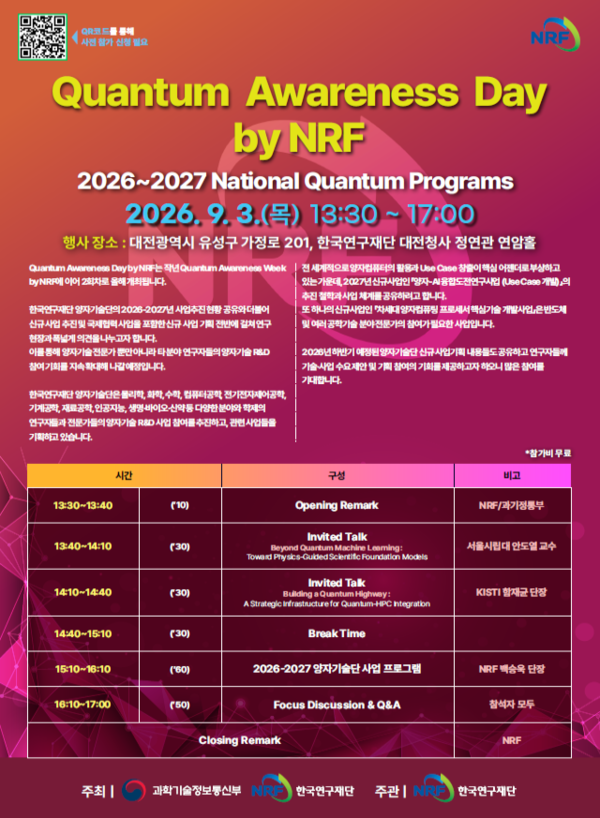
The ministry will hold a 'Quantum Technology Understanding Day' event on Sept. 3 at the National Research Foundation of Korea's Daejeon office.
The event follows the government's decision last month to select the quantum field as a next-generation frontier area among the future growth engines known as the 'seven SEED'. Academic societies and researchers in AI and computer engineering, semiconductors and electronic engineering, materials and chemistry, and new drugs and biotechnology, as well as industry officials, will take part to discuss directions for convergence between quantum technology and other fields.
In an invited lecture, Do-yeol Ahn (안도열), an honorary distinguished chair professor at Seoul City University, will present on the topic 'Beyond quantum machine learning: scientific foundation models led by physical laws'. He will point to the limits of data-centric quantum machine learning and present a development direction for scientific foundation models that incorporate physical laws into learning.
Jae-gyun Ham (함재균), head of the Korea Institute of Science and Technology Information (KISTI), will introduce a strategy to build a hybrid execution environment that links quantum computers and supercomputers. His topic is 'Building a quantum highway: strategic infrastructure connecting quantum computers and supercomputers'.
At a project briefing session, the ministry will share directions for 추진 new programmes including the 'Quantum-AI Convergence Challenge Research Programme' and the 'Ion trap and photonic integrated circuit quantum processor core technology development programme'. The ministry also plans to gather views from the field, including proposals for new research topics, through focused discussions and a question-and-answer session.
Kim Sung-soo (김성수), director general for research and development policy at the ministry, said, "Quantum can accelerate innovation when researchers who best understand the challenges of each industry participate together." He added, "We will support multidisciplinary convergence and the discovery of industrial use cases so that industry, academia and research institute researchers in diverse fields can participate in national R&D programmes in the quantum field."
 Jin-ho Lee
jhlee26@d-today.co.kr
Jin-ho Lee
jhlee26@d-today.co.kr