
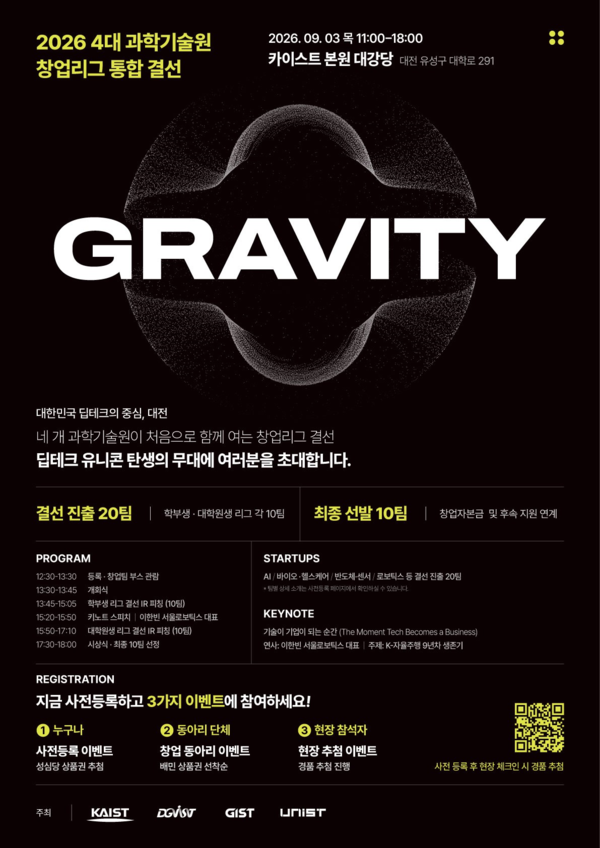
The Ministry of Science and ICT is holding a joint startup competition to support deep-tech startups by students at four science and technology institutes.
The ministry will hold the final round of the "Joint Startup League of the Four Science and Technology Institutes: Gravity 2026" on Sept. 3 at the Korea Advanced Institute of Science and Technology (KAIST).
Gravity 2026 is a student startup competition jointly hosted by KAIST, Gwangju Institute of Science and Technology (GIST), Daegu Gyeongbuk Institute of Science and Technology (DGIST) and Ulsan National Institute of Science and Technology (UNIST).
A total of 310 teams applied this year. The ministry used a 39.8 billion won supplementary budget for deep-tech startup support at the four institutes, set in April, to expand support from about 8 teams to 140 teams.
The competition was run in separate undergraduate and graduate leagues, taking into account participants' startup capabilities and technology maturity. Since June, it has provided expert mentoring, tailored startup education and startup activity funding. A total of 20 teams advanced to the finals, including 10 undergraduate teams and 10 graduate teams.
Finalists will present their technological differentiation, market entry strategies and commercialisation plans in an investment pitching format. A panel of startup and investment experts, including Kakao Ventures, Bluepoint and Korea Investment Accelerator, will evaluate the differentiation of the technology and business model, marketability and growth potential.
After that, 10 top teams selected as winners, 5 each from the undergraduate and graduate leagues, will receive awards including the science ministry minister's prize, institute president's prize and institute startup dean's prize, along with prize money of up to 200 million won by ranking. Follow-up support will also be provided, including a global acceleration programme, overseas demonstrations and investment linkages.
The ministry will also announce "Five key directions for deep-tech startup support at the four science and technology institutes" on the day. Following the establishment of startup centres at GIST, DGIST and UNIST in July, it plans to build a full-cycle support system from identifying companies to technology maturity, global expansion, talent development and overseas scaling.
Kim Sung-soo (김성수), head of the R&D Policy Bureau at the Ministry of Science and ICT, said Gravity 2026 shows how South Korea's research capabilities lead to market innovation. He said the ministry will continue support so that young scientists, including those at the four institutes, can take on the challenge of starting businesses and be active on the global stage.
 Jin-ho Lee
jhlee26@d-today.co.kr
Jin-ho Lee
jhlee26@d-today.co.kr