
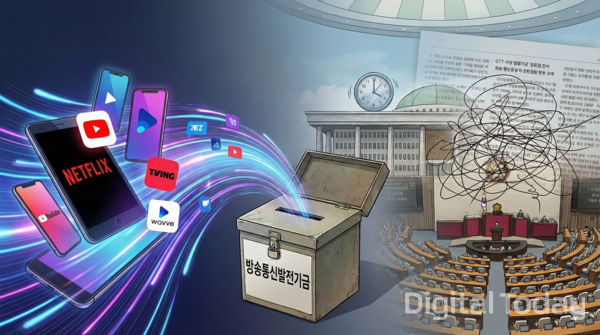
South Korea's media industry sovereignty has shifted to online video services, but talks on reshaping the Broadcast and Telecommunications Development Fund remain stuck. A funding crunch has become reality as advertising revenue at traditional broadcasters has plunged. Yet institutional reform remains difficult, blocked by controversy over reverse discrimination between domestic and overseas OTT platforms and concerns about trade.
According to the National Assembly's bill information system on Monday, an amendment to the Framework Act on Broadcasting and Telecommunications Development proposed by Democratic Party lawmaker Cho In-cheol and others shortly after the 22nd National Assembly opened has been pending for 18 months after subcommittee review in September 2024. Equity issues around the fund have been discussed in the National Assembly since 2022. But the debate has shown no clear progress even after a change of administration and shifts in the composition of parliament.
Under the current system, the fund is collected from terrestrial broadcasters, general programming channels, news channels and pay-TV operators based on broadcast advertising sales. OTT platforms are classified as value-added telecommunications service providers and are excluded from collection.
The bill includes provisions to collect up to 1 percent of sales from OTT operators whose sales or user numbers exceed a certain level. It is based on the view that OTT platforms also benefit from broadcasting and telecommunications infrastructure and a user-protection environment funded by the levy, and should share public responsibility.
Pressure on funding is rising as broadcasters' earnings weaken. According to the Korea Communications Commission's recently released 2025 survey of broadcasting and telecommunications advertising spending, broadcast advertising revenue last year fell 5.0 percent from a year earlier to 321.91 billion won. Over the same period, the online advertising market including OTT rose 8.2 percent to 1.02 trillion won.
Even though the need for collection is clear, revamping the system is not easy due to complex interests. The biggest obstacle is the possibility of regulatory reverse discrimination between domestic and foreign operators. Domestic OTT platforms such as Tving and Wavve are paying network usage fees and content delivery network costs to telecom companies even as they remain loss-making, and there are concerns their competitiveness could be undermined if they also face a new levy burden. There is also the problem that it is realistically difficult to compel global OTT platforms such as Netflix and Disney+ to pay into the fund.
A domestic industry official said, "If we cannot secure effective enforcement power to collect from global operators that do not even pay network usage fees, domestic companies will end up facing double regulation."
In politics, there is an atmosphere of concern about trade friction. At a U.S.-South Korea summit last year, the two countries specified in an official document a clause pledging not to discriminate against U.S. companies in digital services policies, including network usage fees and online platform regulation.
Global OTT platforms say they contribute through direct investment rather than a levy. Netflix pledged to invest 330 billion won in Korean content over four years from 2023. Based on 2024 figures, Netflix Korea's revenue was 899.7 billion won, exceeding France's mandatory reinvestment standard of 20 to 25 percent of local sales.
Experts say the fund needs a fundamental redesign. An Jeong-sang, head of the Korea OTT Forum, said imposing a levy on domestic OTT platforms amid losses would be a double burden and, without guaranteed enforcement on overseas operators, would create reverse discrimination. He said global OTT investment methods such as IP monopolisation could harm the domestic industry's ability to stand on its own and that there is an urgent need for sophisticated policy design reflecting changes in the media environment.
 Seulgi Son
sageson@d-today.co.kr
Seulgi Son
sageson@d-today.co.kr