
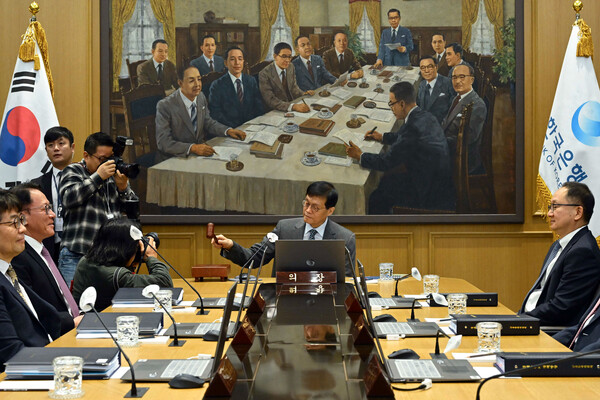
The Bank of Korea is expected to keep its benchmark interest rate unchanged at its first Monetary Policy Board meeting of the year. With the exchange rate still high and volatile, analysts say there is a lack of a decisive trigger that could lead to a shift in policy stance when considering an uneven economic recovery and financial imbalance factors.
South Korea’s financial sector expects the Bank of Korea to hold its first policy meeting of the year on Jan. 15 to set the benchmark rate. Markets broadly agree that the rate will be kept unchanged.
Min Ji-hee, an analyst at Mirae Asset Securities, said in a report that a rate hold is likely at the January meeting. With the won-dollar exchange rate fluctuating around 1,450 won, she judged that factors behind won weakness remain in place despite government measures to stabilise dollar supply and demand, including upward revisions to U.S. economic growth, weakened export competitiveness excluding semiconductors and increased overseas stock investment by South Korean residents. She also noted that the central bank governor recently signalled a view that the current exchange-rate level is somewhat high relative to fundamentals.
Kim Chan-hee, an analyst at Shinhan Investment Corp, also expected the benchmark rate to be held. He said a dissenting view favouring a rate cut from member Shin Sung-hwan, and forward guidance that signals a cut within three months, are also likely to remain the same as in November last year. He cited the lack of meaningful changes when considering fundamentals and financial imbalance conditions overall.
Markets commonly point to whether forward guidance changes, the growth outlook and the Bank of Korea’s stance on the exchange rate and inflation as key points to watch at this meeting.
Min said it is likely that the number of members expecting a rate cut within three months in the forward guidance will remain at 3 out of 6. The minutes of the November meeting showed 5 of the 6 members at the time expressed concern about imbalanced growth across sectors and weak private-sector employment. The governor also made clear in New Year remarks that a K-shaped economic recovery is not sustainable.
On the fundamentals, Kim said the K-shaped recovery centred on semiconductors is continuing. He said semiconductor exports are rising steadily but a recovery in items excluding semiconductors remains weak.
Consumer trends are also mixed. Retail sales and consumer sentiment have slowed as the effect of consumption coupons faded, but the absolute level of the consumer sentiment index is still at its highest since 2021. Low-income households’ sentiment has weakened again, while consumption sentiment among middle- and high-income households influenced by wealth effects remains relatively steady, the analysis said.
Inflation is tracking the central bank’s projected path. Consumer prices rose 2.3 percent in December from a year earlier, continuing a stable trend. Kim said improved energy supply conditions have somewhat eased concerns about rising import prices despite geopolitical variables.
Growth outlook upgraded? Financial imbalances a burden
Views on the growth outlook differ somewhat. Min said markets have raised South Korea’s 2026 growth forecast to 2 percent, but the actual indicators suggest further upgrades warrant caution. She cited rising export prices due to higher semiconductor prices, while volume growth is slowing, and corporate facility investment is struggling to rebound. She also said it is a burden that in past semiconductor upcycles, export growth repeatedly slowed 2 to 3 quarters after DRAM prices hit a peak.
On financial imbalances, mixed signals are emerging around the exchange rate and property. Kim pointed to a growing possibility that overheating in the property market could spread. Seoul apartment price gains far exceed the stability level targeted by the government, and the pace of jeonse price increases in both the Seoul metropolitan area and outside the region is also rising quickly, he said. The exchange rate remains high.
Recent remarks by policy board members also offer limited clues of a policy shift. Member Kim Jong-hwa stressed close monitoring of the exchange rate’s impact on inflation and the economy, and member Jang Yong-seong voiced concern about a build-up of financial imbalances due to rising home prices centred on the Seoul metropolitan area. Governor Lee Chang-yong also reiterated in his New Year address that the exchange rate in the mid-to-high 1,400 won range is high relative to fundamentals, along with a growth structure concentrated in the IT sector.
Still, discussion of how to run forward guidance may become more concrete. Kim said measures such as introducing a dot plot or extending the forward-guidance horizon to up to 1 year could be considered. He said the Bank of Korea is likely to remain cautious given that the gap between projections and actual decisions could widen.
As a result, markets expect the Bank of Korea to maintain a neutral stance for the time being while it checks additional indicators.
Experts also said the first half will involve confirming the recovery path for exports and consumption and the flow of financial imbalances shifting to the exchange rate and property, while expectations for a rate cut could re-emerge as semiconductor-led growth momentum weakens heading into the second half.
Min stressed that what to watch at this meeting will be Governor Lee’s judgement on whether to further raise this year’s growth forecast.
Kim said it is now a period to check variables further as the easing tilt has only just been withdrawn, adding that a wait-and-see mood is likely to dominate as the central bank watches the recovery path for exports and consumption in the first quarter and financial imbalance conditions that show signs of shifting gradually from the exchange rate to property.
 Lee Ji-young
ljy@d-today.co.kr
Lee Ji-young
ljy@d-today.co.kr